
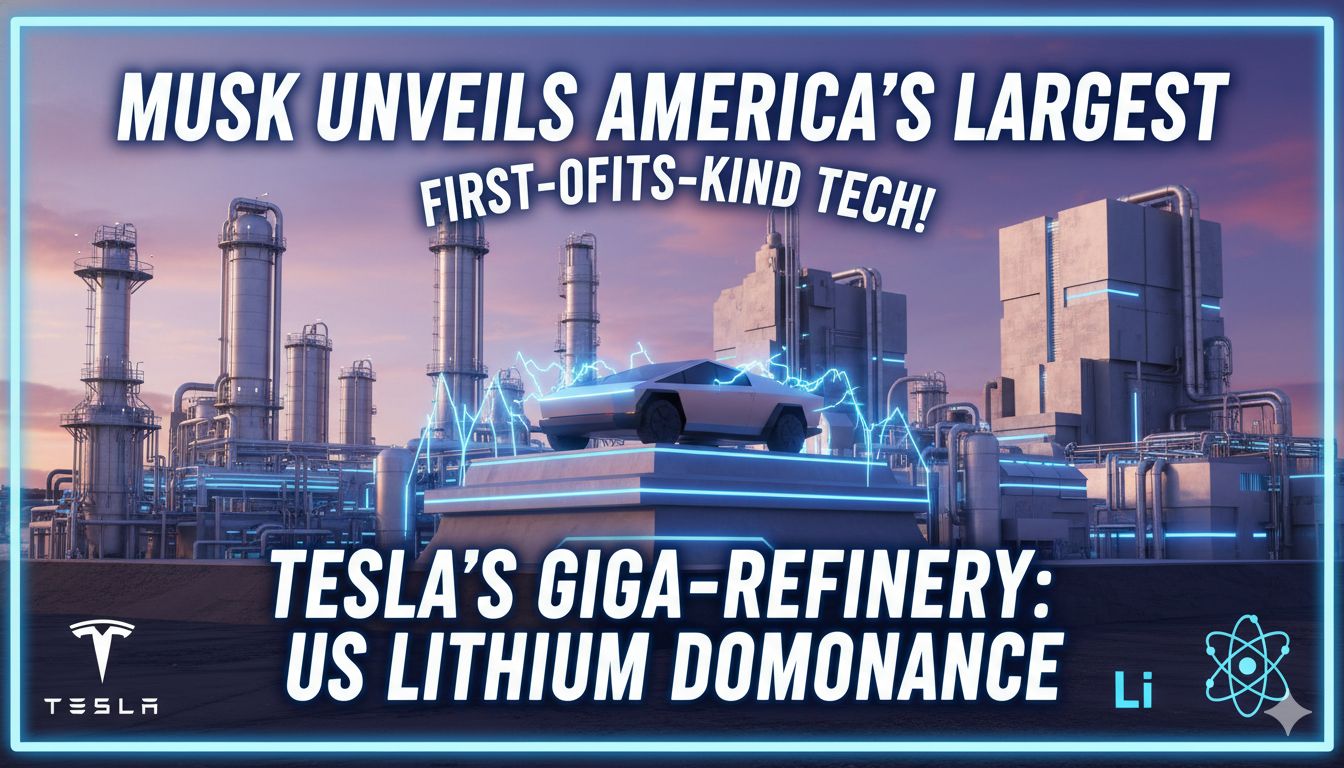
“Tesla has activated its innovative lithium refinery in Corpus Christi, Texas, which Elon Musk describes as the largest in the U.S. and the most advanced worldwide, enabling production of battery-grade lithium hydroxide from raw ore while eliminating hazardous waste and supporting over 500,000 electric vehicles annually.”
Tesla’s Lithium Refinery Revolutionizes North American Supply Chains
Tesla’s new facility processes spodumene concentrate directly into high-purity lithium hydroxide, bypassing traditional intermediate steps that dominate the industry. This approach not only streamlines operations but also generates a benign byproduct—a mix of sand and calcium carbonate—that can be repurposed in construction materials, avoiding the environmental pitfalls of sodium sulfate waste common in other refineries.
The refinery’s scale positions it as a cornerstone for Tesla’s vertical integration strategy, directly feeding battery cell production at its Gigafactory in Texas. By localizing refining, Tesla mitigates risks from global supply disruptions, particularly from regions controlling the majority of worldwide lithium processing capacity.
Key Operational Highlights
Production Capacity : The plant is equipped to produce sufficient lithium for more than 500,000 electric vehicles per year, enhancing Tesla’s ability to meet surging demand for its Model Y and energy storage products.
Environmental Innovations : Unlike conventional methods, Tesla’s process is designed for minimal environmental impact, with Musk emphasizing its cleanliness and efficiency.
Economic Impact : The refinery is expected to create hundreds of jobs in the region, bolstering local economies and contributing to broader U.S. manufacturing resurgence in critical materials.
Financial Implications for Tesla and the EV Sector
With Tesla’s stock trading around $437.50 amid positive market sentiment, this development strengthens the company’s cost structure by reducing dependency on imported refined lithium, which has faced price volatility. Analysts project that internal refining could lower battery costs by up to 20%, improving margins on vehicles and stationary storage units.
The move aligns with Tesla’s record energy storage deployments, where lithium hydroxide is a key component. As electric vehicle adoption accelerates, with U.S. sales projected to exceed 2 million units this year, Tesla’s control over upstream materials provides a competitive edge against rivals reliant on overseas suppliers.
Strategic Advantages in a Competitive Market
| Milestone | Description |
|---|---|
| Groundbreaking | Initiated construction to establish North America’s first integrated spodumene-to-hydroxide facility. |
| Initial Testing | Processed raw materials through key equipment stages, validating the innovative refining method. |
| Full Operation | Achieved operational status, marking a shift toward domestic battery mineral independence. |
Tesla’s refinery challenges the global dominance in lithium refining, where a single region holds approximately 60% of capacity. By bringing this capability stateside, Tesla not only secures its supply chain but also supports national goals for energy security. Musk’s vision extends to recycling integration, where the plant will eventually handle feedstock from used batteries and manufacturing scrap, closing the loop on sustainable production.
This initiative underscores Tesla’s broader push into materials science, complementing advancements in battery chemistry that promise higher energy density and longer vehicle ranges.
Disclaimer: This news report is for informational purposes only and does not constitute investment tips or financial advice. Sources are based on publicly available information.









Leave a Reply