
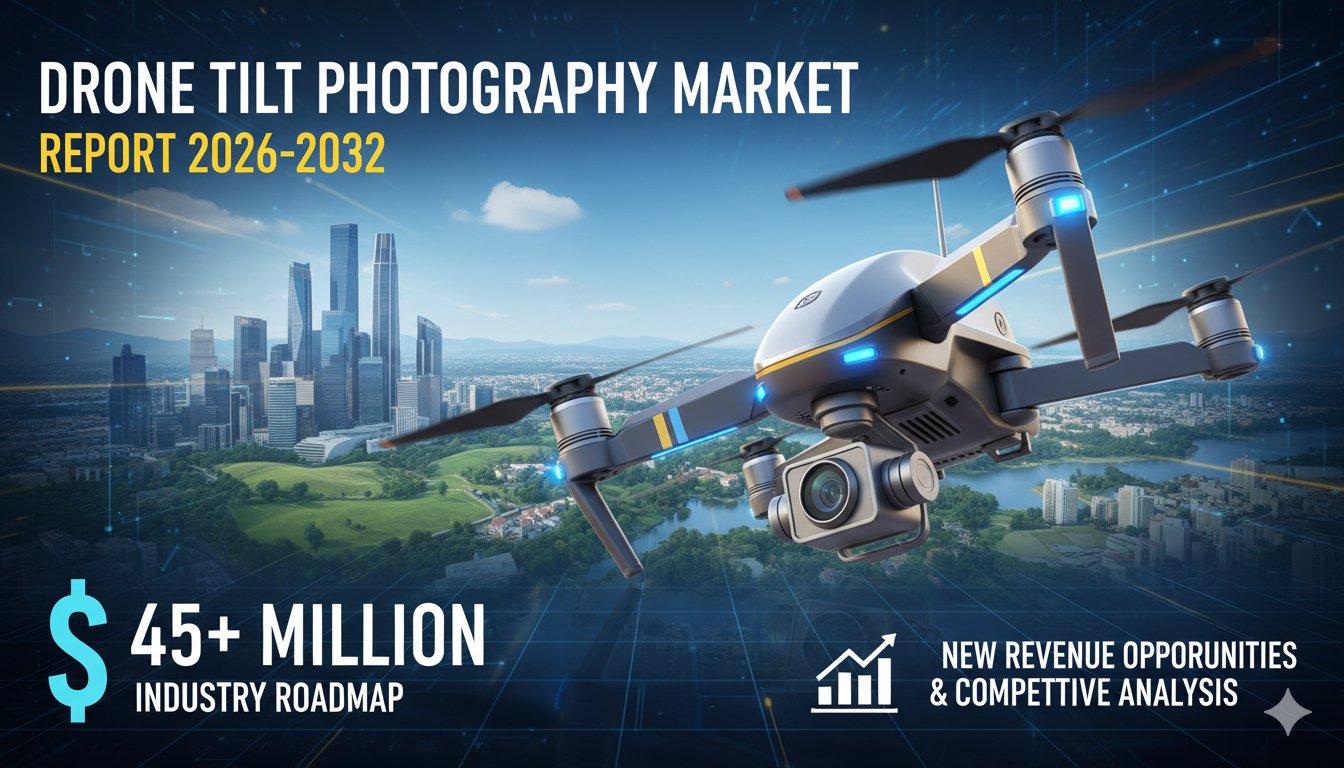
“The drone tilt photography sector is experiencing steady expansion, driven by increasing standardization in oblique imagery capture for industries like real estate, construction, and environmental monitoring. Projections indicate a market value exceeding $45 million by 2032, with an 8.26% CAGR from 2026 onward, fueled by AI integrations and new revenue streams in workflow optimization. Competitive benchmarking highlights leaders focusing on hardware-software synergy, while regional variations underscore opportunities in Americas’ regulatory frameworks and Asia-Pacific’s manufacturing strengths.”
Drone Tilt Photography Market Report 2026-2032
The drone tilt photography industry represents a specialized segment within aerial imaging, emphasizing oblique-angle captures that provide multi-dimensional views for enhanced data analysis. This technique leverages drones equipped with advanced gimbals and sensors to deliver high-resolution imagery, enabling applications that go beyond traditional overhead shots. Industries are increasingly adopting it for its ability to support scalable operations in visual documentation, site inspections, and promotional content creation.
Market Growth Projections
Forecasts show the sector building on its current momentum, with valuations climbing due to technological advancements and broadening use cases. The emphasis on precision and efficiency is attracting investments from both established firms and emerging players.
| Year | Market Size (USD Million) | Key Notes |
|---|---|---|
| 2025 | 25.91 | Baseline growth amid initial standardization efforts |
| 2026 | 32.63 | Acceleration from AI-driven automation |
| 2032 | 45.18 | Cumulative expansion at 8.26% CAGR, surpassing $45 million threshold |
This trajectory reflects a compound annual growth rate of 8.26%, supported by factors such as reduced operational friction through intelligent systems and tighter hardware-software integrations. Buyers are prioritizing solutions that ensure repeatability, minimizing errors in variable environments like urban settings or remote terrains.
New Revenue Opportunities
Emerging streams are tied to innovative procurement strategies and optimized workflows. For instance, service providers can capitalize on subscription-based models for tilt imagery datasets, targeting sectors needing real-time updates for project management. In-house teams benefit from modular platforms that allow customization, opening doors to premium add-ons like enhanced stabilization tech. Additionally, partnerships between drone operators and data analytics firms are unlocking value in post-capture processing, where AI algorithms convert raw oblique images into actionable insights for marketing campaigns or infrastructure assessments. These opportunities are projected to add significant margins, particularly in high-demand areas like energy infrastructure and public safety.
Industry Roadmap
The path forward outlines a structured evolution toward a $45+ million ecosystem by 2032. Short-term milestones include widespread adoption of next-generation gimbals for precise tilt control, aiming for sub-degree accuracy in captures. Mid-term focuses shift to ecosystem depth, with integrations enabling seamless data flow from drone to cloud-based platforms for 3D modeling. Long-term, the roadmap emphasizes resilience against supply chain issues, advocating for diversified manufacturing and firmware upgrades to handle diverse conditions. This blueprint also incorporates regulatory alignment, positioning the industry for scaled deployments in controlled airspaces.
Competitive Benchmarking Analysis
The landscape is moderately concentrated, with market concentration ratios indicating a balance between dominant innovators and niche specialists. Herfindahl-Hirschman Index (HHI) metrics for 2025 suggest healthy competition, avoiding monopolistic risks while encouraging innovation. Product portfolios are benchmarked on criteria like sensor resolution, gimbal versatility, and integration capabilities, with top performers excelling in lifecycle support to reduce downtime.
Key players are advancing through recent developments such as upgraded sensor arrays and collaborative ventures. For example:
Leaders in integrated platforms: Focusing on consumer-prosumer drones for quick setups, these entities hold strong positions in real estate and tourism applications.
Modular system providers: Emphasizing flexibility for professional missions, they benchmark high in engineering and utilities sectors.
Standout performers include firms like SZ DJI Technology Co., Ltd., Skydio, Inc., and Autel Robotics Co., Ltd., which score highly on technology integration and repairability.
Other notable entities: Parrot SA, Yuneec International Co., Ltd., and Trimble Inc. are recognized for robust portfolios in surveillance and environmental monitoring.
Overall, benchmarking reveals that success hinges on mature software development kits (SDKs) and spare-part availability, with top-tier companies achieving up to 20% better ROI through minimized variability.
Regional Insights
Geographic dynamics play a pivotal role, with variations in adoption rates and infrastructure influencing growth.
Americas : Leading with formalized safety protocols and data management standards, this region sees strong uptake in construction and emergency response, bolstered by stringent compliance that ensures reliable operations.
EMEA : Growth is tied to regulatory harmonization and expanding infrastructure, making it ideal for utilities and telecom applications where adaptability to diverse environments is key.
Asia-Pacific : Rapid scaling is driven by a deep manufacturing base and swift technology adoption, positioning it as a hub for agriculture and filmmaking innovations.
Alignment with local standards remains crucial, as tariffs and end-user demands shape segment-specific opportunities across these areas.
Applications and End-User Segments
The versatility of tilt photography extends to multiple fields, where oblique views provide superior detail for decision-making.
Agriculture : Crop and livestock monitoring benefit from angled imagery for terrain analysis and yield optimization.
Construction : Infrastructure and roadway projects use it for progress tracking and site evaluations.
Environmental Monitoring : Pollution detection and wildlife surveys leverage the technique for comprehensive overviews.
Filmmaking & Photography : Cinematography, commercial shoots, and weddings gain dynamic perspectives.
Real Estate : Commercial and residential listings are enhanced with immersive visuals.
Surveillance & Security : Asset monitoring and border patrols rely on detailed oblique captures for threat assessment.
These segments highlight the technology’s role in bridging traditional aerial methods with advanced 3D reconstructions.
Challenges and Strategic Considerations
While promising, the sector faces hurdles like environmental variability and supply disruptions. AI optimizations are addressing capture inconsistencies, while strategic procurement emphasizes resilient designs. Recommendations include evaluating integrations for workflow efficiency and benchmarking against compliance metrics to optimize long-term investments.
Disclaimer: This news report and tips are for informational purposes only and do not constitute financial advice. Sources are based on publicly available data and industry analyses.









Leave a Reply