
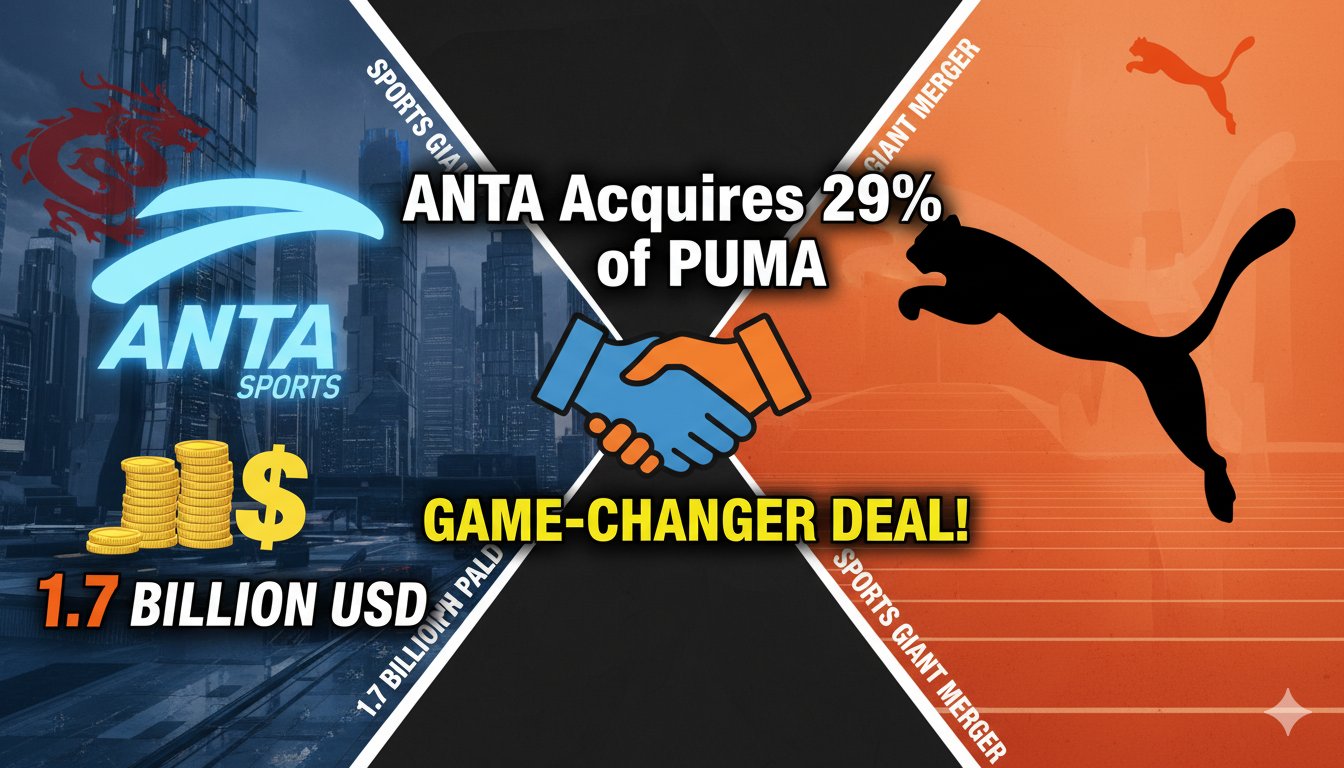
“Chinese sportswear giant ANTA Sports has agreed to purchase a 29.06% stake in German athletic brand Puma from the Pinault family’s investment firm for approximately $1.7 billion in cash, positioning ANTA as Puma’s largest shareholder and advancing its multi-brand globalization efforts. The transaction, priced at a significant premium, aims to leverage complementary strengths in global markets, particularly China, without pursuing a full takeover. Market reactions saw Puma’s shares surge while ANTA’s stock also climbed amid optimism for enhanced brand synergies and growth opportunities.”
Deal Details The agreement involves ANTA Sports acquiring exactly 29.06% of Puma’s shares from Groupe Artémis, the holding company controlled by the Pinault family, who have long been major stakeholders in the German sportswear company. The all-cash transaction is valued at €1.5 billion, translating to roughly $1.7 billion based on current exchange rates. This price equates to 35 euros per share, representing a substantial 62% premium over Puma’s closing share price of 21.63 euros just prior to the announcement. The deal is fully funded through ANTA’s internal cash reserves, demonstrating the company’s strong financial position and commitment to strategic investments without relying on external borrowing or equity issuance. Regulatory approvals from relevant authorities in China, Germany, and potentially other jurisdictions are required, with the closure anticipated by the end of the year. This move does not include any immediate plans for a mandatory takeover bid, as ANTA has emphasized maintaining Puma’s operational independence while seeking board representation to influence strategic directions collaboratively.
Strategic Implications This acquisition aligns seamlessly with ANTA’s long-standing “single-focus, multi-brand, globalization” strategy, which has been a cornerstone of its expansion beyond its core Chinese market. By becoming Puma’s top shareholder, ANTA gains access to a premium global brand with deep roots in sports like football, running, basketball, and motorsport, complementing ANTA’s existing portfolio that includes brands focused on mass-market athletic wear and specialized segments. The partnership is expected to unlock synergies in product development, supply chain efficiencies, and market penetration, particularly in high-growth regions such as Asia. For Puma, which has faced challenges in regaining momentum against dominant players like Nike and Adidas, the deal offers a pathway to bolster its presence in China—the world’s largest sportswear market—where ANTA holds a commanding position with extensive retail networks and consumer insights. Analysts view this as a mutually beneficial arrangement, where ANTA can infuse resources and expertise into Puma’s revival efforts, including innovation in performance gear and lifestyle products, while Puma provides ANTA with enhanced international credibility and distribution channels in Europe, North America, and emerging markets like Latin America and Africa. The emphasis on “arm’s-length” collaboration ensures that both entities preserve their unique brand identities, avoiding integration risks that could dilute consumer loyalty.
Market Reaction The announcement triggered immediate volatility in the stock markets, reflecting investor enthusiasm for the potential value creation. Puma’s shares on the Frankfurt Stock Exchange experienced an initial surge of over 20% in early trading, before moderating to a solid gain of around 8% by midday, pushing the company’s market capitalization higher and signaling confidence in the strategic fit. This premium valuation underscores the perceived undervaluation of Puma’s assets amid recent industry headwinds, including supply chain disruptions and shifting consumer preferences toward sustainable and tech-infused apparel. On the Hong Kong Stock Exchange, ANTA’s shares rose by more than 3% at the open, settling at a 2% increase, with trading volume spiking to over 17 million shares—well above average levels. This positive response highlights ANTA’s track record of successful brand acquisitions and its ability to drive growth in a competitive sector. Broader market sentiment in the sportswear industry also perked up, with peers like Adidas and Li Ning seeing modest upticks as the deal reignites discussions on consolidation and cross-border partnerships. However, some cautionary notes emerged from analysts regarding potential antitrust scrutiny and geopolitical tensions that could impact execution, though overall optimism prevails for long-term shareholder returns.
| Stock Performance Snapshot | Puma SE (PUM.DE) | ANTA Sports (2020.HK) |
|---|---|---|
| Current Price | ~24.50 EUR | 77.90 HKD |
| Daily Change | +8% (approx.) | +2.03% |
| Day’s High | 26.00 EUR | 78.95 HKD |
| Day’s Low | 22.00 EUR | 77.15 HKD |
| Trading Volume | High (elevated) | 16.99M shares |
| Market Cap (approx.) | €7.5B | HK$220B |
Company Profiles ANTA Sports, established over three decades ago, has evolved from a domestic Chinese footwear manufacturer into a multinational powerhouse with a diversified brand ecosystem. Headquartered in Jinjiang, China, the company employs thousands worldwide and operates through a hybrid model of brand management and retail operations, boasting over 10,000 stores in China alone. Its product lines span athletic footwear, apparel, and accessories, with endorsements from high-profile athletes in basketball, running, and outdoor sports. ANTA’s globalization push has included acquisitions of European and American brands, enabling it to penetrate markets in Southeast Asia, the Middle East, Africa, and beyond, while maintaining a strong focus on innovation through R&D centers dedicated to performance materials and sustainable manufacturing. Puma, on the other hand, traces its origins to a family business in Germany that split into the iconic rivalry with Adidas. Today, Puma operates in more than 120 countries, employing around 20,000 people and generating billions in annual revenue from its core categories of sportswear and lifestyle products. Known for its bold designs and collaborations with celebrities and athletes in football, motorsport, and urban fashion, Puma has been navigating a transformation under recent leadership to reclaim market share lost to faster-growing competitors. The company’s strengths lie in its heritage branding, global sponsorship deals, and agile supply chain, though it has grappled with profitability pressures in a post-pandemic economy marked by inflation and e-commerce shifts.
Key Points of the Partnership
Board Influence : ANTA intends to nominate representatives to Puma’s supervisory board, fostering closer alignment on strategic initiatives without overriding management autonomy.
Geographic Synergies : The deal positions Puma for accelerated growth in China, where sportswear demand is projected to exceed $100 billion annually by the end of the decade, leveraging ANTA’s local expertise in consumer trends and distribution.
Product Complementarity : ANTA’s mass-market focus pairs well with Puma’s premium positioning, potentially leading to co-branded lines or shared technology in areas like eco-friendly fabrics and smart wearables.
Financial Health : With no debt incurred for the purchase, ANTA preserves its balance sheet strength, rated highly by credit agencies, while Puma benefits from a stable anchor investor amid volatile equity markets.
Risk Mitigation : Both parties have committed to independent governance, reducing integration challenges, though external factors like trade policies could influence outcomes.
Growth Projections : Industry experts anticipate combined revenue uplift through expanded e-commerce, retail expansions, and marketing campaigns targeting millennial and Gen Z consumers globally.
Future Outlook Looking ahead, the collaboration could catalyze innovation across the sportswear landscape, with potential joint ventures in emerging categories like esports apparel and wellness gear. ANTA’s experience in revitalizing acquired brands suggests Puma could see enhanced operational efficiencies, such as optimized sourcing from Asian suppliers and data-driven inventory management. For U.S. audiences, this deal underscores the rising influence of Chinese firms in global consumer goods, offering American investors exposure to diversified growth stories amid domestic market saturation. Challenges may include navigating cultural differences in branding and adapting to regulatory environments, but the shared vision of unlocking untapped potential positions both companies for sustained competitiveness. As the sector evolves with trends like athleisure and sustainability, this stake acquisition sets the stage for a dynamic alliance that could reshape market dynamics.
Disclaimer: This news report is provided for informational purposes only and does not constitute financial advice, investment tips, or endorsements. All information is based on publicly available sources and should not be relied upon for making investment decisions.









Leave a Reply