
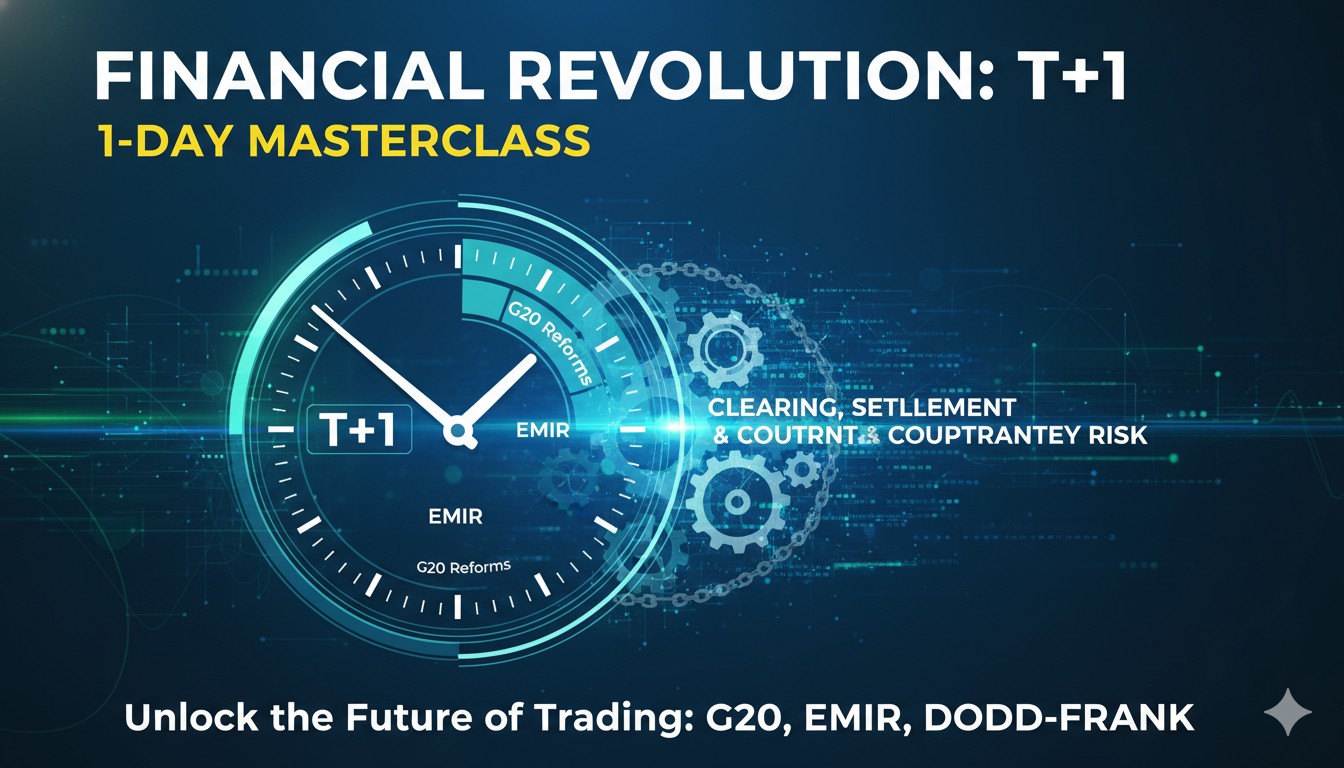
“This intensive one-day training course delivers an in-depth exploration of modern clearing and settlement processes, the critical role of central counterparties in mitigating counterparty risk, and the evolving regulatory landscape shaped by post-crisis reforms. Participants gain practical insights into G20-driven mandates for central clearing, key requirements under EMIR and Dodd-Frank, and the operational implications of the U.S. transition to T+1 settlement, which has reduced systemic exposure while demanding heightened efficiency in post-trade operations.”
Detailed Article Body
The financial industry’s post-trade infrastructure has undergone profound transformation since the 2008 global financial crisis, driven primarily by international commitments to enhance transparency, reduce systemic risk, and strengthen counterparty risk management. A specialized one-day training course focused on clearing, settlement, and counterparty risk stands out as an essential resource for professionals navigating these changes. This program offers a structured, comprehensive review of mechanisms that ensure trades are finalized securely and efficiently, while addressing the regulatory pillars that continue to reshape global markets.
At the core of the course is an examination of clearing and settlement fundamentals. Clearing involves confirming trade details between parties, calculating obligations, and often netting positions to minimize exposures. Settlement then transfers securities and funds to complete the transaction. In traditional bilateral arrangements, counterparty risk—the possibility that one party defaults before fulfilling its obligations—posed significant threats, as seen during the crisis when interconnected failures amplified losses across institutions.
Central counterparties (CCPs) emerged as a key solution to this vulnerability. By interposing themselves between buyers and sellers through novation, CCPs become the buyer to every seller and the seller to every buyer. This structure mutualizes risk and enforces robust risk management practices, including daily mark-to-market valuations, initial and variation margin requirements, and default management procedures. The course details how CCPs maintain financial resilience through dedicated default funds, skin-in-the-game contributions from members, and stress testing to withstand extreme scenarios.
A major focus is the G20 reforms initiated at the Pittsburgh Summit in 2009, which committed leaders to mandate central clearing for standardized over-the-counter (OTC) derivatives, impose higher capital and margin requirements for non-cleared trades, and promote trading on organized platforms where feasible. These reforms aimed to shift opaque bilateral markets toward transparent, resilient structures. Implementation has been largely successful in major jurisdictions, with a substantial portion of interest rate swaps, credit default swaps, and other derivatives now cleared centrally, significantly lowering bilateral counterparty exposures.
In the United States, the Dodd-Frank Wall Street Reform and Consumer Protection Act translated these commitments into law through Title VII. It established mandatory clearing for certain swap categories deemed appropriate by regulators, required swap execution facilities for standardized products, and mandated reporting to trade repositories for greater visibility. The framework has enhanced oversight by the Commodity Futures Trading Commission and Securities and Exchange Commission, while pushing institutions to adopt more disciplined risk practices. The course explores how these rules have influenced market structure, including the growth of registered CCPs and the reduction in systemic leverage from uncleared positions.
Across the Atlantic, the European Market Infrastructure Regulation (EMIR) mirrors many Dodd-Frank objectives but with distinct features tailored to the EU’s fragmented landscape. EMIR requires clearing through authorized CCPs for eligible OTC derivatives, introduces bilateral margining for non-cleared trades, and establishes trade repositories for reporting. It also includes active account requirements and measures to limit excessive reliance on a single CCP. The training highlights EMIR’s emphasis on equivalence decisions for cross-border recognition of CCPs, ensuring seamless operations while protecting EU financial stability.
A timely and critical component of the course addresses the shift to accelerated settlement cycles, particularly the U.S. move to T+1. Implemented on May 28, 2024, this change shortened the standard settlement period for most securities transactions—including equities, corporate bonds, municipal securities, ETFs, and certain mutual funds—from T+2 to T+1. Coordinated with Canada and Mexico, the transition aimed to reduce credit, market, and liquidity risks inherent in unsettled trades, lower clearing fund requirements at central infrastructure providers, and improve capital efficiency.
Post-implementation assessments indicate the U.S. T+1 rollout has been smooth, with stable fail rates, reduced overall risk exposures, and operational efficiencies realized across participants. The course examines the preparatory efforts required, such as automating allocation and confirmation processes, standardizing settlement instructions, and enhancing intraday liquidity management. It also discusses implications for global investors, including time-zone challenges for Asia-Pacific firms dealing with North American securities, and the need for precise coordination in cross-border flows.
Looking ahead, the training covers ongoing global trends toward further compression. With approximately 55% of global market activity now settling on T+1 and projections reaching 85% by 2028, other regions are following suit. The EU, UK, and Switzerland have aligned on an October 11, 2027, target for T+1 adoption, supported by industry roadmaps emphasizing pre-settlement automation by late 2026, improved data standards, and mitigation of funding frictions in securities financing transactions.
Participants in this course benefit from practical discussions on integrating these elements into daily operations. Key topics include:
Margin calculation methodologies and collateral optimization strategies
Default waterfalls and recovery mechanisms at CCPs
Compliance challenges in cross-jurisdictional clearing
Operational adjustments for T+1, including earlier affirmation deadlines and real-time monitoring
Risk metrics for assessing counterparty exposures pre- and post-clearing
Professionals from trading desks, risk management, compliance, operations, and post-trade functions find the content directly applicable to enhancing resilience amid regulatory evolution.
Disclaimer: This article is for informational purposes only and does not constitute financial, investment, legal, or regulatory advice. Market conditions and regulations can change rapidly.








Leave a Reply