
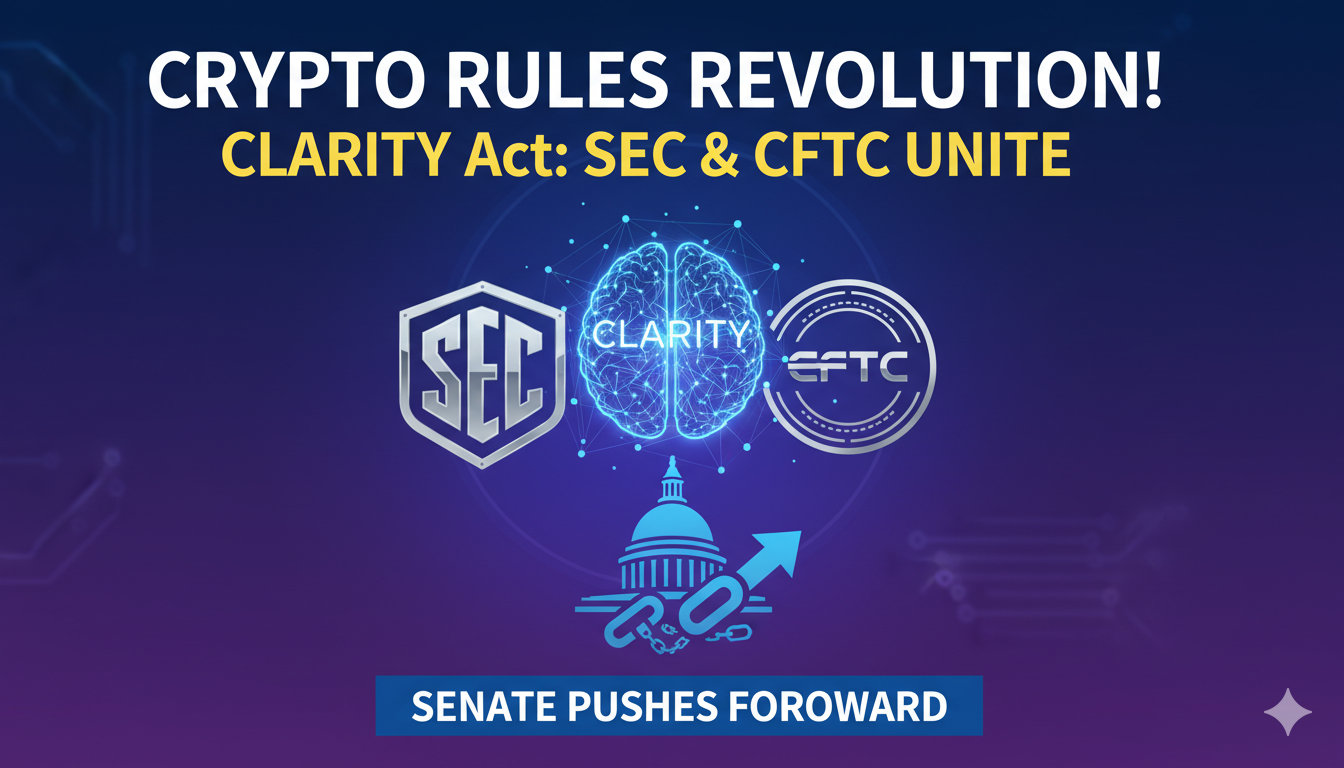
The Digital Asset Market Clarity Act (CLARITY Act) is building significant momentum in 2026, with the SEC and CFTC demonstrating unprecedented coordination through their joint Project Crypto initiative, while Senate committees advance related market structure legislation. Following its bipartisan passage in the House in July 2025, the bill now faces key negotiations amid White House mediation on contentious issues like stablecoin yields. SEC Chair Paul Atkins and CFTC Chair Michael Selig have publicly endorsed the framework, emphasizing the need for statutory clarity to replace enforcement-heavy approaches, protect investors, and position the U.S. as the global leader in digital assets. Recent hearings and agency alignments signal that comprehensive crypto rules could reach the President’s desk in the coming months, potentially transforming the regulatory landscape for spot markets, intermediaries, and innovation.
Detailed Legislative Progress and Regulatory Alignment
The CLARITY Act, formally known as the Digital Asset Market Clarity Act of 2025 (H.R. 3633), represents a landmark effort to establish a clear federal framework for digital assets by delineating jurisdiction between the Securities and Exchange Commission (SEC) and the Commodity Futures Trading Commission (CFTC). The legislation passed the House of Representatives in July 2025 with strong bipartisan support in a 294-134 vote, marking a pivotal shift from years of regulatory uncertainty driven by enforcement actions.
At its core, the bill classifies digital assets based on their characteristics: assets tied to investment contracts or centralized systems fall under SEC oversight as securities, while decentralized, mature blockchain-based commodities shift to CFTC regulation. This division aims to provide predictable rules for spot markets, secondary trading, and intermediaries. Key provisions include safe harbors for decentralized finance (DeFi) developers and validators, requirements for disclosures during token offerings, and mechanisms for tokens to transition from securities to commodities once blockchain systems achieve maturity—defined by decentralization, functionality, and lack of issuer control.
Secondary transactions in digital commodities that originated as investment contracts receive tailored treatment, exempting them from certain securities registration requirements under specific conditions, with the SEC retaining authority to mandate disclosures for investor protection. The bill also prohibits Federal Reserve involvement in central bank digital currencies (CBDCs) for monetary policy and includes anti-surveillance measures.
Since its House passage, the bill has advanced to the Senate, where it was referred to the Committee on Banking, Housing, and Urban Affairs. Initial markup sessions faced delays in January 2026 due to debates over amendments, particularly restrictions on stablecoin yields and rewards. Industry players, including major exchanges and issuers, pushed back against broad prohibitions on interest-like rewards for stablecoin holders, arguing they stifle innovation and consumer benefits. White House-facilitated meetings between crypto firms and traditional banking representatives sought compromises, with a reported target for resolution by early March.
Despite setbacks, momentum has rebuilt. In late January 2026, the Senate Agriculture Committee advanced the Digital Commodity Intermediaries Act on a party-line vote (12-11), a measure that builds directly on the CLARITY Act by expanding CFTC authority over digital commodity spot markets, brokers, dealers, and exchanges. This includes expedited registration processes and provisional statuses for intermediaries, while incorporating definitions for blockchain maturity, network tokens, and exclusions for certain assets like payment stablecoins.
The Senate Banking Committee has held oversight hearings where SEC Chair Paul Atkins reiterated strong support for the CLARITY Act, describing it as essential to “future-proof” the regulatory framework and prevent backsliding from agency guidance alone. Atkins highlighted the agency’s readiness to implement the legislation swiftly upon enactment.
Parallel to congressional action, the SEC and CFTC have deepened collaboration. In January 2026, Chairs Atkins and Selig relaunched Project Crypto as a unified interagency effort, moving beyond past jurisdictional tensions toward harmonized rulemaking, joint guidance, and exemptions for on-chain activities. This includes potential innovation exemptions expected later in the year and coordinated oversight of tokenization and market infrastructure.
Recent developments include Treasury Secretary Scott Bessent’s call for spring passage to provide market comfort amid volatility, and optimism from industry leaders like Ripple CEO Brad Garlinghouse, who suggested high likelihood of enactment by late spring or April. Negotiations continue on conflict-of-interest provisions, such as restrictions on senior officials’ crypto holdings, with suggestions that filling regulatory vacancies could facilitate deals.
Key Impacts on Market Participants
Exchanges and Intermediaries : The framework would require registration with the appropriate agency, with CFTC overseeing spot digital commodity trading and SEC handling securities-like offerings.
Issuers and Developers : Enhanced disclosure rules for initial offerings, but safe harbors for decentralized protocols once maturity is certified.
Investors : Stronger protections through clear classifications, reduced enforcement surprises, and anti-fraud measures.
Innovation : Exemptions for on-chain movements and DeFi, aiming to keep development onshore.
Current Status Overview
| Aspect | Details | Timeline/Status |
|---|---|---|
| House Passage | H.R. 3633 passed 294-134 in July 2025 | Completed |
| Senate Referral | Referred to Banking Committee in September 2025 | Ongoing |
| Senate Ag Committee | Advanced related Digital Commodity Intermediaries Act (Jan 2026) | Advanced (party-line) |
| Senate Banking Markup | Delayed in January 2026 over stablecoin provisions | Pending new date |
| Agency Coordination | Project Crypto relaunched as joint SEC-CFTC initiative (Jan 2026) | Active |
| White House Mediation | Meetings on stablecoin yields; compromise urged by March 1 | Ongoing |
| Potential Enactment | Spring 2026 target cited by officials | High momentum |
The alignment between regulators and legislative progress underscores a maturing approach to crypto oversight, balancing innovation with safeguards in a rapidly evolving market.
Disclaimer: This is a news report based on publicly available information and does not constitute financial, investment, or legal advice. Readers should conduct their own research and consult professionals before making decisions related to digital assets or regulations.










Leave a Reply