
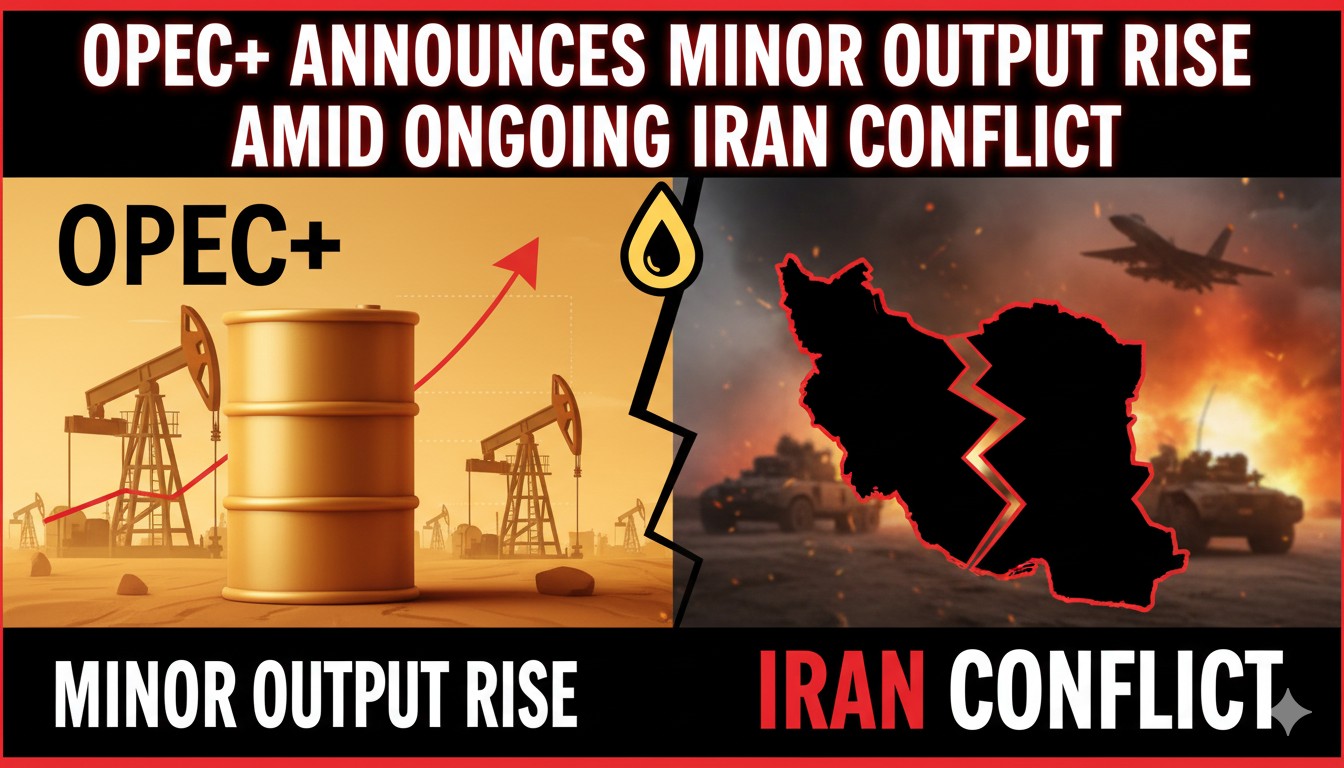
OPEC+ has decided to raise oil production by 206,000 barrels per day starting in April 2026, a modest adjustment described as a response to stable global economic conditions and healthy market fundamentals. This comes as the ongoing U.S.-Israeli military actions against Iran and Tehran’s retaliatory strikes disrupt oil shipments across the Middle East, particularly through the Strait of Hormuz. The increase, involving eight key members including Saudi Arabia and Russia, ends a three-month pause in hikes but represents less than 0.2% of global supply and is unlikely to offset current supply risks, with oil prices surging sharply on renewed geopolitical tensions.
OPEC+ Output Decision in the Shadow of Middle East Turmoil
The OPEC+ alliance, through its core group of eight voluntary cut participants—Saudi Arabia, Russia, Iraq, the United Arab Emirates, Kuwait, Kazakhstan, Algeria, and Oman—has greenlit a production adjustment of 206,000 barrels per day effective April 2026. This move resumes the gradual unwinding of previous voluntary reductions after a deliberate pause from January through March to account for seasonal demand softness.
The decision follows extensive deliberations where options ranged from a more conservative 137,000 barrels per day to higher figures up to around 548,000 barrels per day. The final figure exceeds pre-meeting analyst expectations for a continuation of the prior 137,000 barrels per day increments seen in late 2025 but remains restrained given the extraordinary circumstances.
This adjustment is part of a broader strategy that began in 2025 to phase out layered voluntary cuts totaling several million barrels per day. From April through December 2025, the group had already restored approximately 2.9 million barrels per day in quotas, equivalent to roughly 3% of global demand at the time. Additional voluntary reductions from earlier years, including those announced in 2022, 2023, and beyond, have been progressively eased, leaving the alliance with remaining capacity to adjust flexibly based on evolving conditions.
Market observers note that the hike is largely symbolic in the current environment. The added volume equates to a tiny fraction of worldwide oil demand and comes at a moment when actual supply disruptions far outweigh any marginal increase in output from these producers.
Geopolitical Escalation Disrupts Key Oil Flows
The announcement arrives against the backdrop of intensified conflict in the Middle East. U.S. and Israeli strikes on Iranian targets, including significant military and leadership impacts, have prompted widespread retaliation from Tehran directed at regional installations and assets. These developments have severely hampered oil and gas movements, most critically through the Strait of Hormuz.
This narrow chokepoint handles approximately 15-20 million barrels per day of crude oil—representing a substantial portion of global seaborne trade—along with significant liquefied natural gas volumes from Qatar and others. Recent incidents, including attacks on vessels transiting the strait and temporary closures or halts in traffic, have brought tanker flows to a near standstill. Insurance providers have pulled back coverage, further deterring shipments.
Beyond Hormuz, disruptions include reported strikes on facilities in Saudi Arabia, Qatar, and other Gulf states, adding layers of uncertainty to export capabilities from key OPEC+ members themselves. Iran’s own exports, primarily directed to Asian markets like China, face heightened risks, potentially forcing buyers to seek alternative sources and amplifying upward pressure on prices.
Analysts emphasize that the duration of any Hormuz restrictions will determine the market’s trajectory far more than OPEC+’s paper increase. A prolonged blockage could constrain global supply significantly, overshadowing the group’s modest addition. Even short-term interruptions have already triggered volatility, with rerouting or delays compounding logistical strains.
Oil Market Reaction and Price Dynamics
Benchmark prices have responded aggressively to the unfolding events. Brent crude, the international standard, has climbed sharply, moving from levels around the low $70s before the escalation to trading in the high $70s to low $80s range amid the initial market reaction. WTI crude has followed a similar path, reflecting broad risk premiums tied to supply fears.
The surge reflects trader concerns over potential sustained disruptions rather than the OPEC+ hike itself, which many view as negligible in offsetting risks. If Hormuz access remains limited, analysts project further upside, with some scenarios envisioning prices approaching or exceeding $100 per barrel in extreme cases of extended conflict. Conversely, a swift resolution could see a partial retracement as alternative supplies from non-Gulf producers come online.
The group’s statement deliberately avoids referencing the conflict, focusing instead on positive global economic signals and market balance. This framing underscores OPEC+’s commitment to flexibility—retaining the ability to pause, accelerate, or reverse adjustments as needed in future monthly reviews.
Implications for Global Energy Balance
The eight members involved in this adjustment hold substantial spare capacity in normal times, but current regional constraints limit immediate utilization. Saudi Arabia and the UAE, in particular, face export challenges if Gulf shipping remains impaired. Russia, a non-Gulf producer, contributes to the increase but operates outside the immediate conflict zone.
Broader OPEC+ compliance and the next scheduled review in early April will provide further clarity. The alliance has historically demonstrated adaptability in crisis, prioritizing market stability over rigid quotas.
For U.S. consumers and businesses, the near-term outlook points to elevated gasoline and heating oil costs as refiners pass through higher crude expenses. Industrial users dependent on energy inputs may see margin pressures, while airlines and transportation sectors brace for volatility.
This output decision highlights the delicate balance OPEC+ must strike: signaling readiness to support demand while navigating unprecedented geopolitical headwinds that threaten to redefine supply realities.
Disclaimer: This is a news report based on market developments and does not constitute financial advice, investment recommendations, or endorsements of any kind.







Leave a Reply