
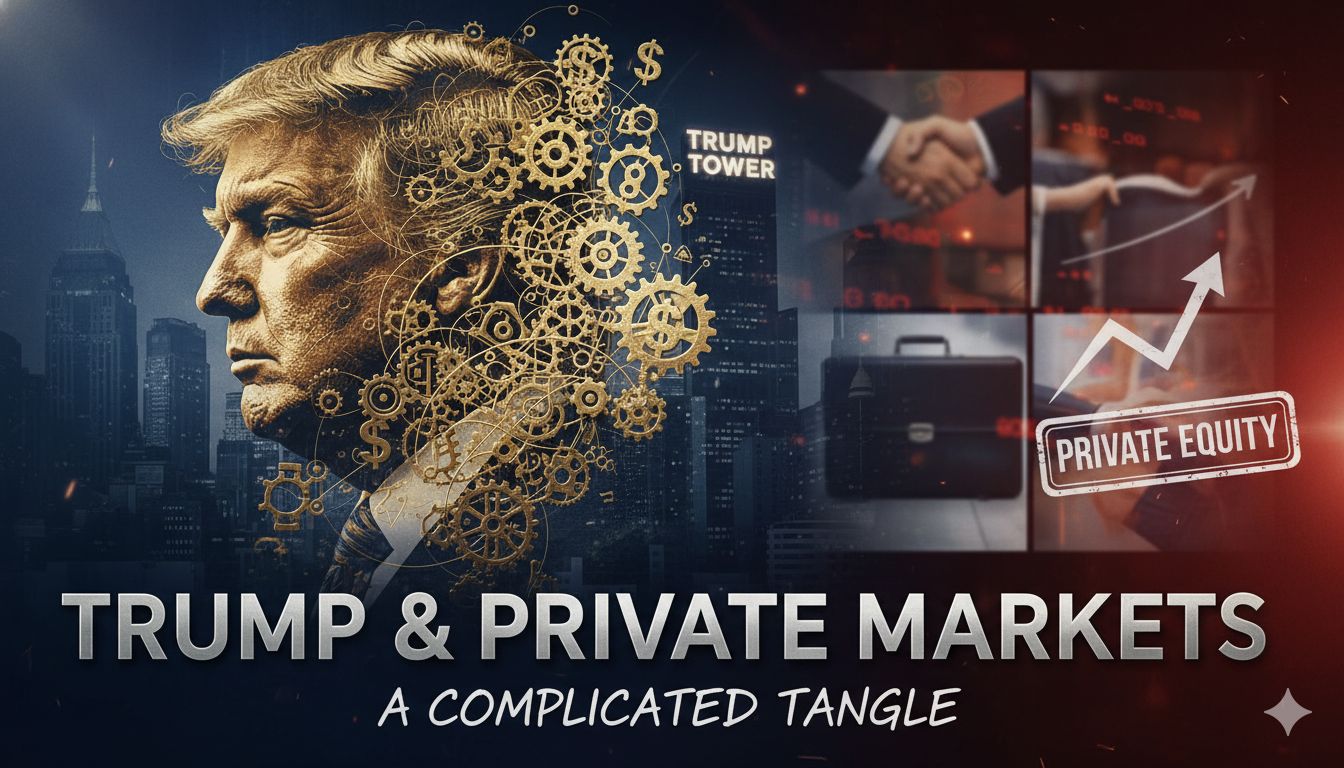
President Donald Trump’s engagement with private markets blends enthusiastic support through deregulation and access expansion with direct government interventions that blur lines between public policy and private investment. From pushing private equity into retirement plans to taking equity stakes in strategic companies, the administration rewards industry allies while asserting unprecedented state influence, creating tensions between free-market rhetoric and activist governance.
Detailed Analysis
Donald Trump’s relationship with private markets—encompassing private equity, hedge funds, venture capital, private credit, and alternative investments—has evolved into one of the most intricate dynamics in modern American finance. Supporters from the sector played a pivotal role in his political ascent, providing funding and personnel, yet the administration’s actions reveal a multifaceted approach: championing deregulation and broader access on one hand, while deploying direct government equity stakes and industrial policy tools on the other.
Private fund leaders, managing trillions in assets, have found favor in key appointments. The Treasury Department is led by a former hedge fund manager, while other high-profile roles draw from private equity backgrounds, including figures with ties to major firms. This influx reflects gratitude for campaign support from industry titans who viewed a second Trump term as an opportunity for lighter regulation, preserved tax advantages like carried interest, and reduced scrutiny on partnerships.
A signature policy move came in August 2025 with an executive order aimed at democratizing access to alternative assets in 401(k) and similar defined-contribution retirement plans. The order directs regulators, including the Department of Labor and SEC, to reexamine fiduciary guidance under ERISA, rescind prior cautions about private equity risks, and encourage inclusion of private market investments, real estate, digital assets like cryptocurrencies, infrastructure, and commodities. Proponents argue this levels the playing field, allowing everyday Americans to tap into higher potential returns historically reserved for institutional investors and wealthy individuals. Industry estimates suggest even modest allocations—such as 10% of 401(k) assets—could channel hundreds of billions into private markets, boosting demand for funds from firms like Blackstone, KKR, and Apollo.
Critics, however, highlight the illiquidity, opacity, and volatility of these assets, warning that retail investors in retirement plans could face significant downsides during downturns, with lock-up periods limiting access to funds when needed most. The policy reversal from prior administrations underscores a pro-industry tilt, potentially benefiting private equity’s push into retail channels through evergreen funds, semi-liquid structures, and partnerships with major asset managers.
Beyond access expansion, the administration has embraced an activist stance, with the government acquiring direct equity stakes in private-sector companies deemed critical to national security and economic competitiveness. Over the past year, stakes or agreements have been secured in at least 10 firms, often in strategic sectors like semiconductors, rare earths, lithium, and steel. Notable examples include a 10% equity position in Intel via the Commerce Department, a golden share in the U.S. Steel acquisition by a foreign entity, investments in MP Materials for rare earth magnets, and stakes in Lithium Americas and others through restructured loans or incentives.
This approach positions the U.S. government as a long-term strategic investor, using tools like CHIPS Act funds, Defense Production Act authority, and export controls to shape corporate decisions and counter foreign competition. Officials describe these moves as necessary to onshore supply chains and protect against dumping or monopolies, with private capital leveraged alongside public commitments. The model draws comparisons to hedge fund-style activism, where the state identifies undervalued or vital assets, intervenes aggressively, and seeks value creation—contrasting with more passive industrial policies of previous eras.
Yet this interventionism creates complexities. While deregulation eases burdens on private funds—such as backing off certain IRS audits—the direct stakes introduce potential conflicts, market distortions, and questions about government influence over corporate governance. Appointees with ongoing or past ties to private equity firms raise ethics concerns, even with divestitures, as financial relationships can persist in limited forms.
The relationship also intersects with broader economic tools like tariffs and trade policies, which some private equity managers view warily for disrupting global supply chains and complicating dealmaking. Despite initial enthusiasm for regulatory relief, isolationist tendencies have forced funds to adjust models, factoring in higher costs and reshoring pressures.
Trump’s personal ventures add another layer, with his media company exploring structural changes like spinning off its social platform amid mergers into new sectors, though these remain distinct from core private market engagements.
Overall, the administration’s posture rewards private markets with capital inflows and lighter oversight while asserting state power in ways that challenge traditional free-market boundaries. This duality—pro-business yet interventionist—defines a complex era for private capital, where industry gains come alongside heightened government involvement in investment outcomes.
Disclaimer: This is a news analysis piece based on publicly available information and does not constitute financial, investment, or legal advice. Views expressed are for informational purposes only.








Leave a Reply