
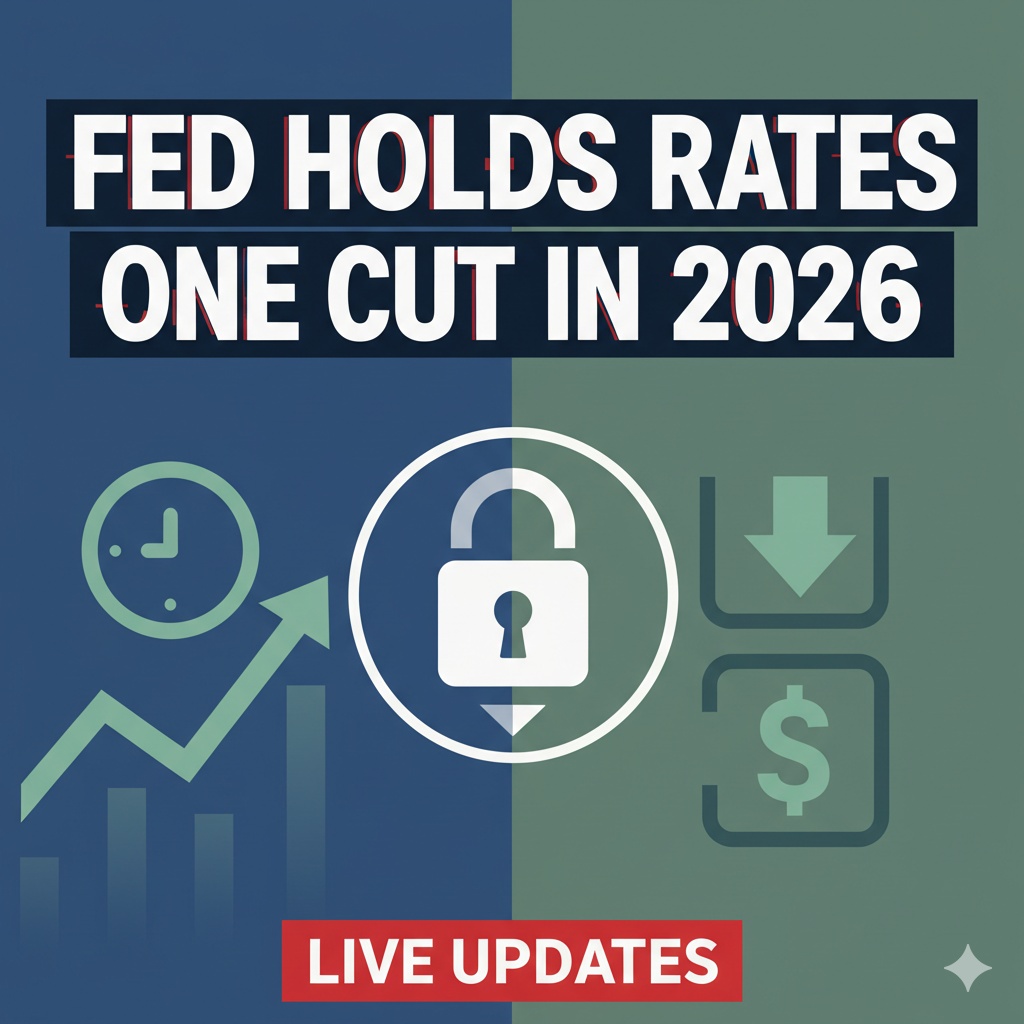
The Federal Reserve decided to keep its benchmark federal funds rate unchanged in the 3.5%–3.75% target range following its March meeting, marking the second consecutive pause this year. Officials’ latest Summary of Economic Projections, including the dot plot, continues to anticipate a single 25-basis-point rate reduction in 2026, with another expected in 2027. Updated forecasts show modestly stronger GDP growth for this year and next, steady unemployment around 4.4% in 2026, but higher inflation expectations for both headline and core PCE measures due to persistent pressures and external uncertainties, including geopolitical factors such as the ongoing war with Iran. The decision reflects a cautious approach amid solid economic expansion, moderating but still elevated inflation, and a softening yet resilient labor market.
Federal Reserve Maintains Policy Stance Amid Evolving Economic Landscape
The Federal Open Market Committee concluded its March policy meeting by voting to leave the target range for the federal funds rate at 3.5% to 3.75%, where it has resided since late last year. This hold follows three quarter-point reductions implemented across the final months of 2025, after which the central bank shifted to a wait-and-see posture in early 2026.
Policymakers emphasized that economic activity continues to expand at a solid pace. Recent data indicate robust consumer spending and business investment supporting growth, even as some softening appears in certain sectors. Job gains have moderated but remain positive, with the labor market still described as balanced overall, though signs of cooling have emerged in hiring trends and wage growth.
Inflation remains somewhat elevated relative to the Fed’s 2% longer-run objective. Both headline and core personal consumption expenditures (PCE) price measures show stickiness above target, influenced by lingering supply-side effects and recent energy price dynamics tied to global events.
The updated Summary of Economic Projections (SEP) released alongside the decision provides key insights into the committee’s collective outlook.
GDP Growth : Median projection for 2026 revised upward to 2.4% from 2.3% in the prior December estimates. For 2027, the median stands at 2.3%, up from 2.0%.
Unemployment Rate : Expected to hold at 4.4% by the end of 2026, unchanged from previous forecasts, before easing slightly to 4.3% in 2027 (revised higher from 4.2%).
Inflation : Headline PCE inflation projected at 2.7% for 2026 (up from 2.4% previously), with core PCE also at 2.7% (up from 2.5%). For 2027, both measures are seen at 2.2%, modestly higher than earlier views.
The dot plot, which aggregates individual policymakers’ views on the appropriate federal funds rate path, shows the median expectation for one 25-basis-point cut in 2026, bringing the target range to 3.25%–3.50% by year-end. This matches the December projection. Dispersion exists among participants: roughly equal numbers anticipate no cuts or one cut this year, with a smaller group penciling in more aggressive easing.
For 2027, the median path incorporates another cut, targeting around 3.0%–3.25% by the end of that year, with rates stabilizing thereafter toward the longer-run neutral level.
The policy statement highlighted elevated uncertainty surrounding the economic outlook, particularly the implications of geopolitical developments, including the war with Iran and its potential effects on energy markets and broader price pressures. Officials remain attentive to risks on both sides of the dual mandate—maximum employment and price stability—indicating readiness to adjust policy if incoming data warrant.
Market reactions following the announcement were relatively muted, with Treasury yields edging slightly lower in some maturities and equity indexes showing limited movement. The decision aligns closely with expectations, as traders had priced in near-certainty of no change at this meeting.
Looking ahead, the Fed’s path will remain highly data-dependent. Key upcoming indicators include monthly employment reports, inflation readings, and consumer spending figures, all of which will inform whether the anticipated single cut materializes later in 2026 or if conditions necessitate a reassessment. The committee reiterated its commitment to supporting sustainable growth while returning inflation to target over time.
Disclaimer: This is general news and analysis based on publicly available economic data and policy announcements. It is not investment advice, personalized financial guidance, or a recommendation to buy, sell, or hold any securities. Economic forecasts involve uncertainty and are subject to change.









Leave a Reply