
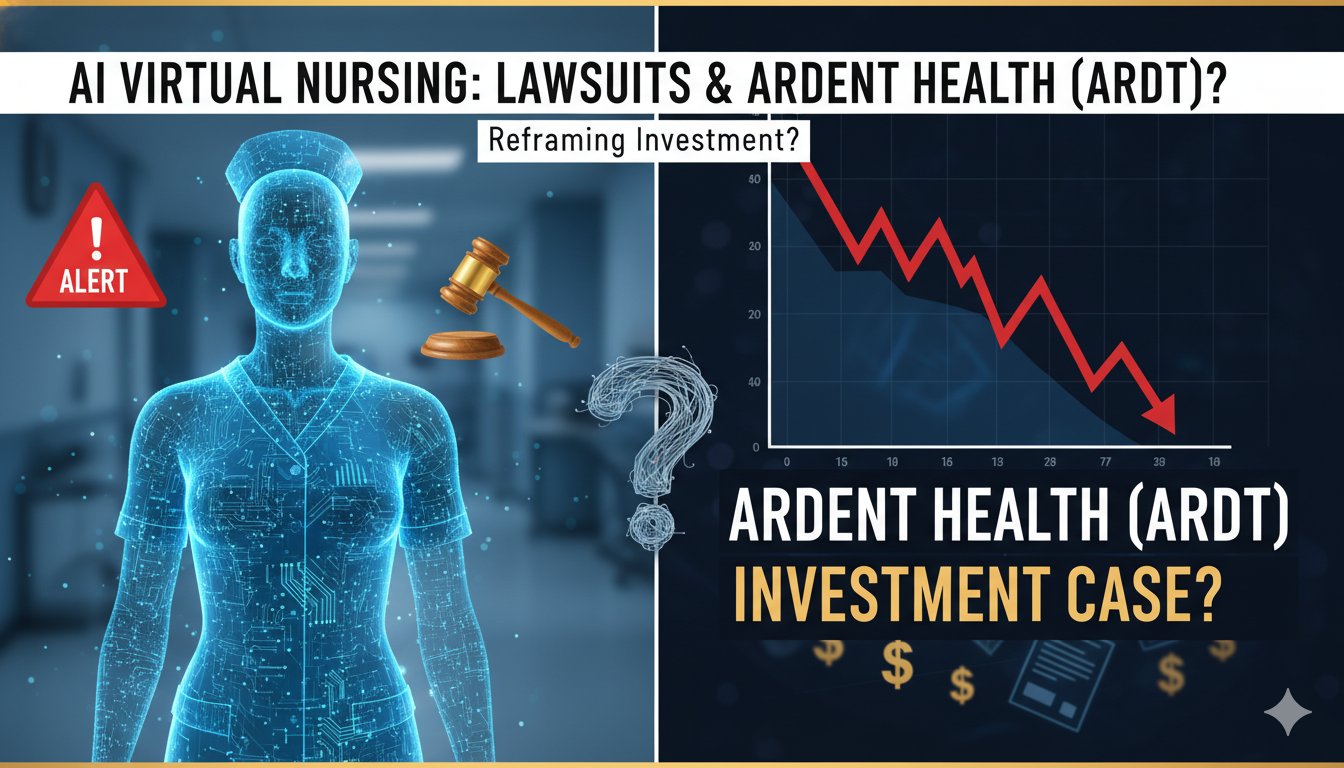
“Ardent Health’s recent partnership to deploy AI-assisted virtual nursing across thousands of patient rooms comes amid ongoing securities class action lawsuits alleging misleading disclosures on accounts receivable collectability, which triggered a sharp 33% stock drop in November 2025. Trading near multi-month lows around $9.50 with a market cap of approximately $1.36 billion, the company’s forward-looking AI initiatives in virtual care could offer long-term operational efficiencies and cost savings in a labor-constrained industry, potentially reframing the investment thesis despite near-term legal and financial headwinds.”
Is AI Virtual Nursing Amid Securities Lawsuits Reframing the Investment Case for Ardent Health (ARDT)?
Ardent Health, Inc. (NYSE: ARDT), a major operator of hospitals and healthcare facilities in mid-sized urban markets across the United States, has been aggressively pursuing technology-driven solutions to address persistent challenges in clinical staffing and patient safety. In late February 2026, the company announced a significant enterprise-wide partnership with hellocare.ai to implement AI-assisted virtual nursing, virtual physician services, telehealth, and advanced patient safety monitoring capabilities. This deployment targets more than 2,000 patient rooms and aims to standardize and expand existing virtual care programs already in place at select facilities.
The hellocare.ai platform incorporates artificial intelligence for key functions such as fall prevention, fall detection, and pressure injury prevention. These tools are designed to augment frontline nursing staff by automating non-physical tasks, reducing documentation burdens, and enabling remote monitoring and intervention. Virtual nursing programs allow experienced clinicians to handle routine assessments, patient education, and coordination from centralized hubs, freeing bedside nurses to focus on hands-on care. Ardent has positioned this as a strategic response to ongoing workforce shortages, rising operational costs, and the need to improve patient outcomes in diverse inpatient settings.
This move builds on earlier pilots within the Ardent network. For instance, facilities have previously tested similar AI-powered virtual nursing solutions to streamline workflows in emergency departments and other high-acuity areas. By scaling these efforts enterprise-wide, Ardent aims to extend clinical capacity, enhance safety protocols, and support retention of nursing talent amid industry-wide pressures. The integration of AI in these areas could lead to measurable reductions in adverse events, shorter lengths of stay in some cases, and better resource allocation—factors that directly influence reimbursement rates and profitability in value-based care models.
However, the enthusiasm for these innovations must be weighed against significant near-term challenges. Ardent’s stock has faced substantial pressure following disclosures in November 2025 that revealed a $43 million decrease in third-quarter revenue, tied to issues with accounts receivable collectability and increased claim denials from third-party payers. The revelation caused shares to plummet more than 33%, falling from around $14.05 to $9.30 in a single session. Multiple securities class action lawsuits have since been filed in the U.S. District Court for the Middle District of Tennessee, alleging violations of federal securities laws under Sections 10(b) and 20(a) of the Securities Exchange Act of 1934.
The complaints center on claims that, during the period from July 18, 2024 (around the time of the company’s IPO), through November 12, 2025, Ardent and certain executives made misleading statements about the company’s accounts receivable framework. Plaintiffs argue that the company did not adequately disclose reliance issues or promptly write off uncollectible amounts, instead using a 180-day reservation policy that delayed loss recognition and inflated reported figures. Lead plaintiff deadlines in these cases extend to March 9, 2026, and the litigation could result in prolonged uncertainty, legal expenses, and potential settlements that impact cash flow.
As of late February 2026, ARDT trades in the $9.40–$9.80 range, well below its 52-week high near $15.59 and closer to the low of $8.07. The market capitalization hovers around $1.36–$1.4 billion, reflecting a price-to-earnings ratio in the low single digits based on trailing earnings. Volume has been elevated during periods of news flow, indicating active trader interest in the story.
Key Financial and Operational Metrics (Approximate, Recent Trading Data)
Current Price: ~$9.50
52-Week Range: $8.07 – $15.59
Market Cap: ~$1.36 billion
Trailing P/E Ratio: ~6.4–6.8
Recent Daily Volume: 400,000–700,000 shares
Enterprise Focus: Hospitals in growing mid-sized markets, with emphasis on cost-effective quality care
Investors evaluating Ardent today confront a bifurcated narrative. On one side, the AI virtual nursing rollout represents a forward-leaning bet on technology to mitigate structural headwinds in healthcare delivery. Successful implementation could drive margin expansion by lowering labor costs per patient day, reducing readmissions, and positioning the company favorably in payer negotiations. The broader healthcare sector has seen AI adoption accelerate for similar reasons—virtual observation and predictive analytics have shown promise in cutting fall rates and improving throughput.
On the other side, the securities litigation introduces material risk. While class actions in this space often resolve without admission of wrongdoing, they can distract management, consume resources, and weigh on sentiment until clarity emerges. The underlying revenue softness tied to collections issues highlights vulnerabilities in reimbursement environments, where payer scrutiny has intensified.
The investment case may ultimately hinge on execution. If Ardent demonstrates tangible ROI from its AI partnerships—through metrics like reduced nurse turnover, fewer safety incidents, or stabilized revenue trends—the stock could find a floor and potentially rebound as legal matters progress. Conversely, prolonged litigation or persistent collections challenges could cap upside.
For long-term holders in the healthcare services space, Ardent offers exposure to a diversified portfolio of assets in underserved markets, combined with a proactive stance on innovation. Short-term traders, however, may view the current valuation as reflecting justified caution amid unresolved uncertainties.
Disclaimer: This is for informational purposes only and does not constitute investment advice, financial recommendations, or legal counsel. Investors should conduct their own due diligence and consult professionals before making decisions.











Leave a Reply