
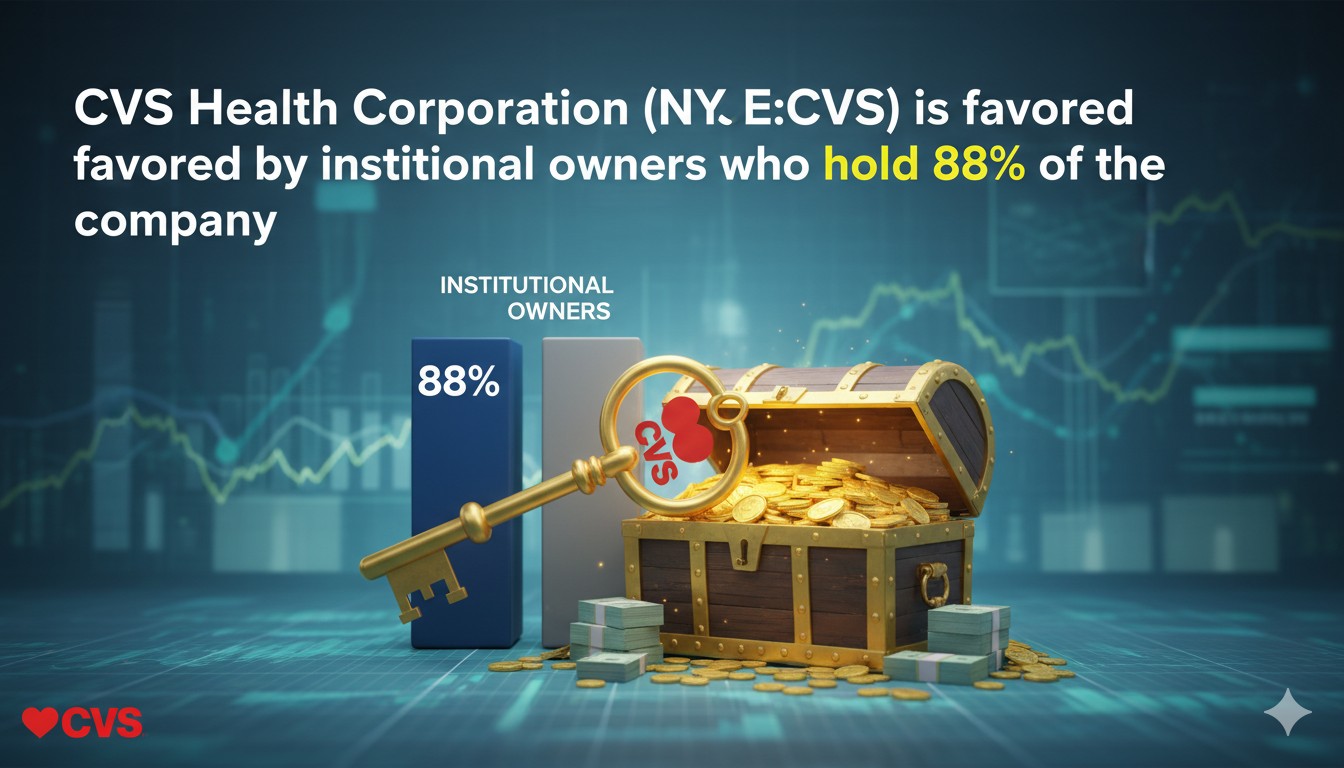
CVS Health enjoys overwhelming support from institutional investors, who control approximately 88% of its shares, signaling deep confidence in the company’s long-term value despite ongoing sector challenges. Major players like BlackRock and Vanguard lead the pack, holding significant stakes alongside other giants such as Dodge & Cox and Capital World Investors. This high institutional concentration, combined with recent strong quarterly results and reaffirmed 2026 guidance, underscores a stable foundation amid healthcare market dynamics.
Institutional Ownership Signals Confidence in CVS Health’s Strategic Position
Institutional investors hold a commanding approximately 88% of CVS Health Corporation’s outstanding shares, reflecting substantial backing from large asset managers, pension funds, and other professional entities. This level of ownership far outpaces retail and insider holdings, with institutions positioned to influence key decisions through voting power and engagement with management.
The dominance stems from the company’s scale as a leading integrated healthcare provider, encompassing retail pharmacy operations, pharmacy benefits management via Caremark, and health insurance through Aetna. Institutions appear drawn to CVS’s diversified revenue streams and its ability to navigate reimbursement pressures, cost controls, and evolving consumer demands in healthcare delivery.
Top institutional holders include BlackRock, Inc., with roughly 9.5% of shares, closely followed by The Vanguard Group, Inc. at about 9.5%. These two passive giants anchor the ownership base, benefiting from index fund inclusions and broad market exposure. Capital World Investors holds around 8.5%, while Dodge & Cox maintains a notable position with active management focus. State Street Corp and others round out the leading group, with the top 13 shareholders collectively controlling about 50% of the company. This distributed yet concentrated structure prevents any single entity from exerting unilateral control while ensuring professional oversight.
Recent data shows more than 2,400 institutions reporting holdings, with total institutional shares exceeding 1.1 billion in various filings. Ownership has remained elevated, with minor quarterly adjustments reflecting rebalancing rather than broad exits. The absence of significant hedge fund presence further highlights a preference for long-term, stability-oriented capital over speculative plays.
CVS Health’s appeal to institutions ties closely to its financial performance and outlook. In the latest quarter, the company delivered total revenues of $105.7 billion, marking an 8.2% increase year-over-year. Adjusted earnings per share came in at $1.09, surpassing expectations, while full-year revenues reached a record $402.1 billion, up 7.8%. These results demonstrate resilience in pharmacy services and health benefits segments despite headwinds like medical cost trends and competitive pricing in reimbursements.
Management has reaffirmed 2026 guidance, projecting GAAP diluted EPS in the range of $5.94 to $6.14 and adjusted EPS between $7.00 and $7.20. Revenue is expected to meet or exceed $400 billion, supported by momentum in Caremark customer wins, retention rates, and ongoing integration efforts from prior acquisitions. Cost discipline, including shifts toward cost-based pharmacy reimbursement models, positions the company to improve margins over time.
The stock currently trades around $78.50, within a 52-week range of $58.35 to $85.15, offering a dividend yield of approximately 3.4%. This yield remains attractive for income-focused institutions, complementing potential capital appreciation from operational improvements.
High institutional ownership often correlates with greater scrutiny and alignment with shareholder interests. These investors monitor metrics like operating cash flow, debt management, and strategic execution in a regulated industry. CVS’s ability to generate consistent cash from operations—evident in recent reports—supports dividend sustainability and potential reinvestment in growth areas such as MinuteClinic expansions and digital health tools.
While retail investors and insiders hold smaller portions—insiders around 1%—the institutional majority provides a stabilizing force. It reduces volatility from short-term sentiment shifts and encourages focus on fundamentals over hype.
Overall, the 88% institutional stake underscores a broad consensus on CVS Health’s role in the evolving U.S. healthcare landscape. With diversified operations, solid earnings momentum, and clear forward visibility, the company remains a favored holding among professional managers seeking exposure to essential services with defensive qualities.
Disclaimer: This is for informational purposes only and does not constitute investment advice, financial recommendations, or a solicitation to buy or sell securities. Investors should conduct their own research and consult professionals before making decisions.









Leave a Reply