
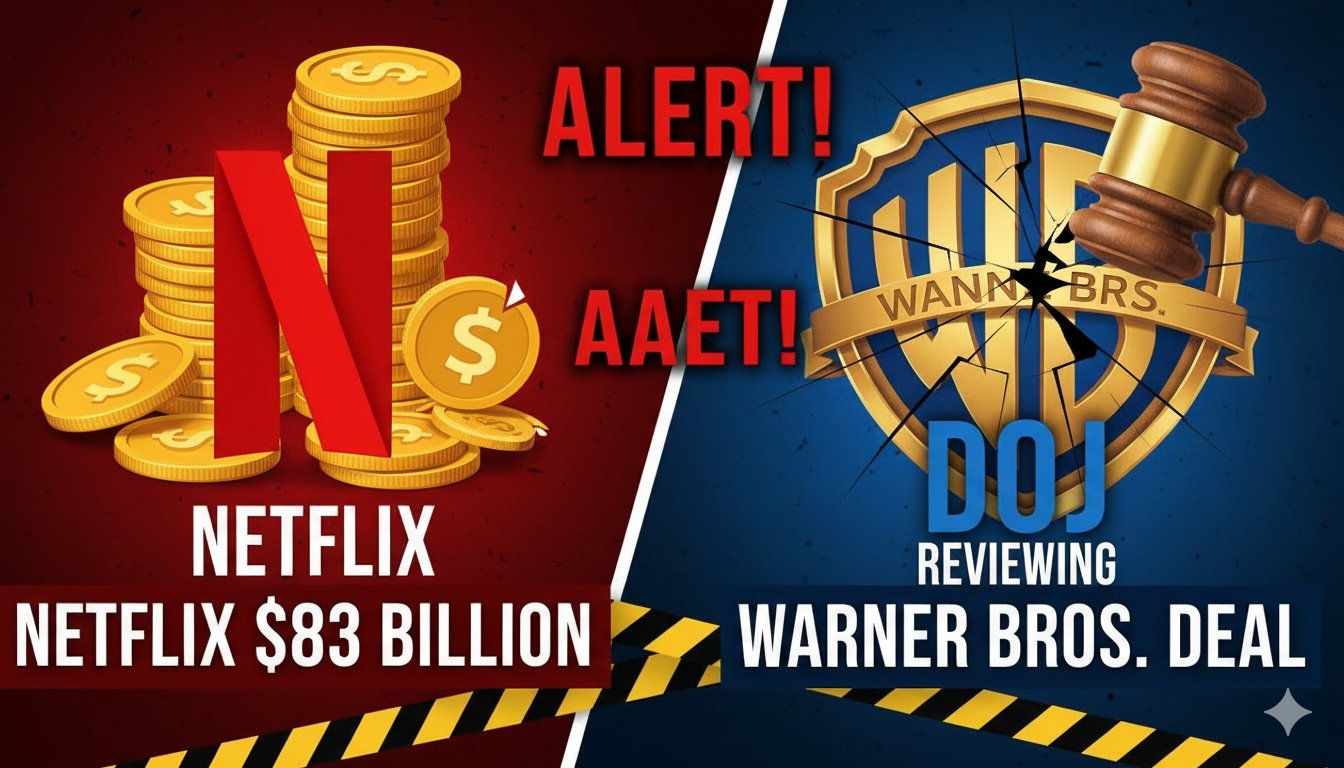
“The U.S. Department of Justice has launched an in-depth antitrust review of Netflix’s $82.7 billion deal to acquire Warner Bros. Discovery’s studios, HBO Max, and games division, issuing second requests for information on January 16, 2026, amid concerns over market dominance in streaming; the agreement was amended to an all-cash structure at $27.75 per share to accelerate a shareholder vote by April, while facing a rival hostile bid from Paramount Skydance at $30 per share for the entire company.”
The U.S. Department of Justice’s Antitrust Division has escalated its examination of Netflix’s ambitious acquisition of key assets from Warner Bros. Discovery, focusing on potential anticompetitive effects in the rapidly evolving streaming landscape. The review process began with Hart-Scott-Rodino filings submitted by both companies on December 17, 2025, triggering a standard 30-day waiting period. However, the DOJ extended this timeline by issuing second requests for additional information and documentary materials on January 16, 2026, requiring substantial compliance from Netflix and Warner Bros. Discovery before the clock resumes. This move signals a thorough investigation, with the waiting period now set to expire 30 days after certification of compliance, potentially pushing regulatory clearance into mid-2026 or beyond.
Under the terms of the deal, initially announced on December 5, 2025, Netflix aims to purchase Warner Bros. Discovery’s film and television studios, the HBO Max streaming service, and its games division for an enterprise value of $82.7 billion, equating to an equity value of approximately $72 billion. The per-share price stands at $27.75, representing a premium over Warner Bros. Discovery’s trading levels prior to the announcement. On January 21, 2026, Warner Bros. Discovery shares were trading around $28.52 ask price, reflecting investor optimism tempered by regulatory uncertainties, while Netflix shares hovered near $83.41 ask price, down slightly amid broader market fluctuations.
The agreement underwent a significant amendment on January 20, 2026, shifting from a mixed cash-and-stock structure—originally about 84% cash—to a fully all-cash transaction. This revision eliminates risks tied to Netflix’s stock volatility, where a decline below certain thresholds could have reduced payouts to Warner Bros. Discovery shareholders. The all-cash format simplifies the deal’s mechanics, enhances value certainty for stockholders, and paves the way for an accelerated shareholder vote anticipated by April 2026. Financing for the transaction has been bolstered to $42.2 billion, secured through a consortium of banks including Wells Fargo, BNP Paribas, and HSBC, supplemented by Netflix’s existing cash reserves.
Regulatory Hurdles and Antitrust Concerns
At the heart of the DOJ’s probe is the potential for the combined entity to dominate the U.S. subscription video-on-demand market, where Netflix and HBO Max together could command roughly 30% market share based on current subscriber metrics. This figure triggers a presumption of illegality under federal merger guidelines, which flag deals that significantly concentrate market power and reduce head-to-head competition. Analysts project that the merger could lead to consolidated control over premium content pipelines, potentially limiting options for consumers and raising barriers for smaller streaming platforms.
The investigation will likely delve into market definitions, pitting a narrow view of paid streaming services against a broader entertainment ecosystem that includes free platforms like YouTube and TikTok. Netflix executives have argued that the deal fosters innovation and consumer benefits by securing long-term access to iconic franchises such as Harry Potter, Batman, and Game of Thrones, while enabling cost synergies estimated at $2 billion to $3 billion annually by the third year post-closing. These savings would stem from streamlined marketing, technology infrastructure, and distribution operations.
Beyond the DOJ, the transaction faces parallel scrutiny from the European Commission, with filings under both the EU Merger Regulation and Foreign Subsidies Regulation. Additional pre-closing notifications are required in over 20 merger control jurisdictions and 10 foreign investment authorities across South America, Asia, and Europe. The overall timeline for closure remains 12 to 18 months from the original agreement date, contingent on these approvals and the planned spin-off of Warner Bros. Discovery’s global linear networks business—branded as Discovery Global—expected 6 to 9 months prior to the deal’s finalization. This spin-off includes assets like CNN, TNT, TBS, HGTV, Food Network, and Discovery+, with targeted net debt reduced to $17.0 billion as of June 30, 2026, and further to $16.1 billion by year-end, bolstered by stronger 2025 cash flows.
Breakup provisions add financial stakes: Netflix would owe Warner Bros. Discovery $5.8 billion if regulators block the deal, while Warner Bros. Discovery faces a $2.8 billion fee for terminating the agreement. These clauses underscore the high-risk nature of the transaction amid heightened antitrust enforcement.
Competitive Landscape and Rival Bids
The deal has ignited a bidding war, with Paramount Skydance launching a hostile all-cash tender offer at $30 per share for the entirety of Warner Bros. Discovery, valuing the company at $108.4 billion including debt. Backed by investors such as David Ellison, Larry Ellison’s Oracle fortune, RedBird Capital Partners, and sovereign wealth funds from Saudi Arabia, Qatar, and Abu Dhabi, this rival proposal encompasses Warner Bros. Discovery’s cable networks, which Netflix’s bid excludes. Paramount argues its offer encounters fewer regulatory obstacles, as it avoids concentrating streaming market share to the same degree, and has initiated legal action to force disclosure of Netflix’s deal financials, including valuation details for the spun-off networks and projections for financing costs.
Warner Bros. Discovery’s board has unanimously rejected multiple overtures from Paramount, deeming them inferior and riskier due to potential debt burdens and integration challenges. Instead, the board endorses the Netflix transaction as superior for shareholders, emphasizing the incremental value from the Discovery Global separation. Paramount has signaled intentions for a proxy fight, nominating board candidates aligned with its bid, which could further complicate the shareholder vote.
Market reactions have been mixed, with Paramount shares trading near recent lows around $11.52, reflecting investor skepticism over its aggressive pursuit. The dueling bids highlight broader industry consolidation trends, where streaming giants seek scale to combat subscriber churn and rising content costs.
Financial Implications and Market Impact
The acquisition promises to reshape Netflix’s balance sheet and operational footprint. Post-deal, Netflix’s debt load could rise significantly, though its robust free cash flow—projected at over $6 billion for 2026—positions it to manage the leverage. The integration of Warner Bros. studios would secure in-house production for high-profile series and films, reducing reliance on third-party licensing and potentially boosting margins from the current 25% operating range.
For Warner Bros. Discovery shareholders, the $27.75 per-share payout, combined with proceeds from the Discovery Global spin-off, offers a clear path to value realization. However, regulatory delays could pressure stock volatility, as evidenced by Warner Bros. Discovery’s 1.2% gain in recent trading sessions amid amendment news.
| Company | Current Ask Price (Jan 21, 2026) | Recent Performance | Market Cap (Approx.) |
|---|---|---|---|
| Netflix (NFLX) | $83.41 | -4.40% daily change | $360 billion |
| Warner Bros. Discovery (WBD) | $28.52 | +1.20% daily change | $70 billion |
| Paramount Global (PARA) | $11.52 | -0.26% daily change | $8 billion |
Broader market implications include potential job impacts in Hollywood, with unions expressing concerns over reduced competition for talent and production deals. The merged entity could command greater negotiating power with advertisers and distributors, influencing ad-supported streaming tiers that now account for 40% of new subscriptions industry-wide.
Strategic Rationale and Future Outlook
Netflix views the acquisition as a strategic imperative to fortify its content moat in a maturing streaming sector, where global paid subscribers exceed 1 billion. By internalizing Warner Bros.’ intellectual property, Netflix aims to accelerate international expansion, particularly in Europe and Asia, where HBO Max holds strong footholds. The games division addition aligns with Netflix’s push into interactive entertainment, potentially integrating titles like those from the DC universe into its mobile gaming offerings.
Challenges persist, including political dimensions, as the incoming administration has voiced reservations about media concentration. The DOJ’s track record in media mergers—such as past challenges to AT&T-Time Warner—suggests a rigorous process ahead, possibly requiring remedies like content licensing commitments or asset divestitures to secure approval.
Disclaimer: This news report and any tips provided are for informational purposes only and do not constitute financial advice or endorsements of any sources.






Leave a Reply