
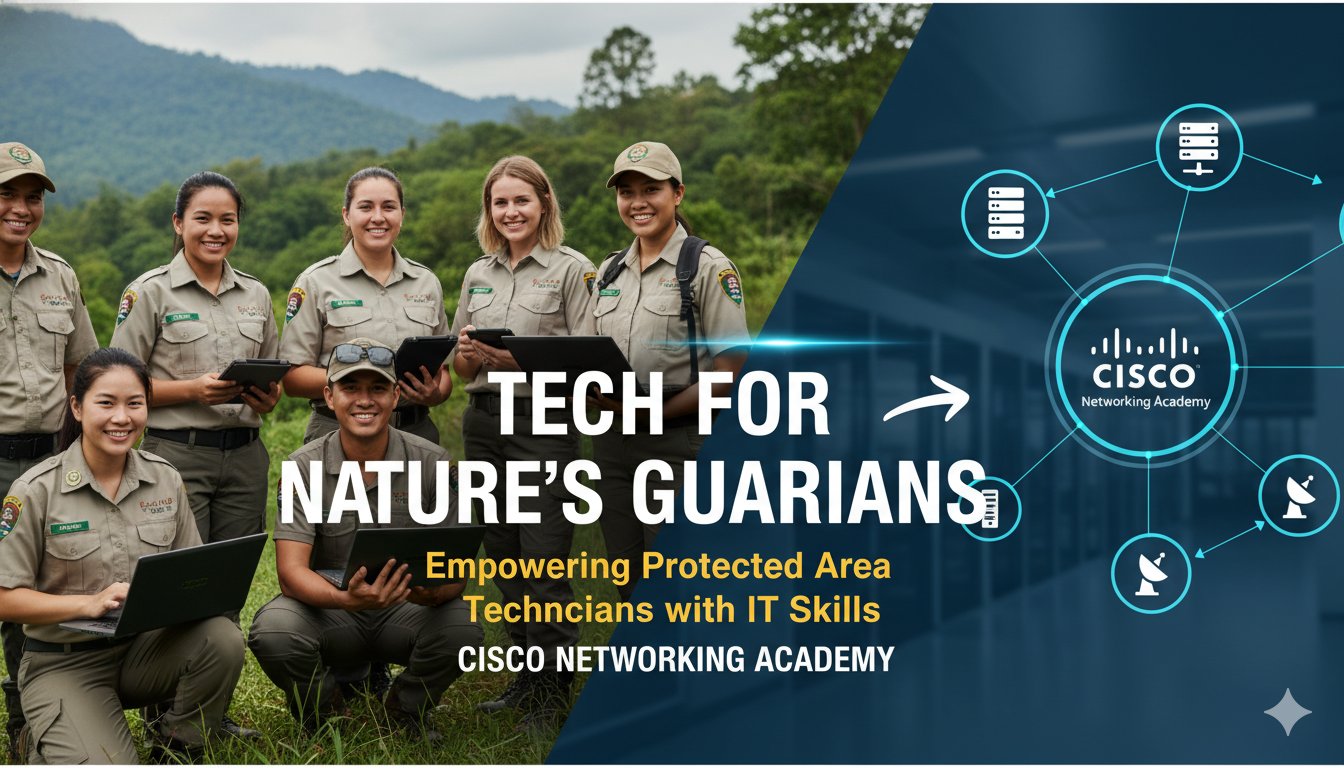
“Cisco Networking Academy’s partnership with the Connected Conservation Foundation has launched a free training program equipping local technicians in protected areas with essential IT skills, fostering job creation in conservation technology while enhancing biodiversity protection across global ecosystems.”
The Protected Area Technician (PAT) Training Program represents a strategic fusion of technology and environmental stewardship, addressing the escalating demand for skilled professionals capable of managing digital tools in conservation zones. This initiative targets technicians in regions where wildlife and natural resources face threats from poaching, habitat loss, and climate variability, providing them with vendor-neutral expertise to deploy and sustain advanced systems.
Key components of the program include a curriculum spanning 10 specialized courses, designed to build foundational and advanced competencies. Entry-level modules focus on basic networking principles, sensor installation, and off-grid power solutions, while advanced tracks delve into cybersecurity protocols, data analytics, and system integration. These skills enable technicians to maintain real-time monitoring networks that track animal movements, detect unauthorized intrusions, and optimize resource allocation in vast protected landscapes.
In economic terms, the program drives workforce development by creating pathways to high-demand roles in the growing conservation tech sector, which is projected to expand significantly amid global sustainability investments. Technicians trained under this umbrella gain certifications that enhance employability, with entry-level credentials like introductory networking badges and advanced ones such as Cisco Certified Support Technician (CCST) endorsements. This not only bolsters local economies in developing regions but also aligns with broader market trends where investors prioritize ESG (Environmental, Social, and Governance) factors, channeling funds into tech-enabled conservation projects.
Program Structure and Curriculum Breakdown
The training is delivered through an online platform, allowing flexible access for participants in remote areas. Here’s a detailed overview of the core courses:
| Course Title | Focus Areas | Duration (Hours) | Key Outcomes |
|---|---|---|---|
| Introduction to Conservation Technology | Overview of digital tools in protected areas, basic sensor deployment | 4 | Understanding tech’s role in biodiversity monitoring |
| Networking Fundamentals | IP addressing, router configuration, wireless connectivity | 8 | Ability to set up secure networks in field environments |
| Off-Grid Infrastructure Management | Solar power systems, battery maintenance, remote device powering | 6 | Skills for sustainable energy solutions in isolated zones |
| Cybersecurity Essentials | Threat detection, encryption, secure data transmission | 7 | Protecting conservation data from cyber risks |
| Data Management and Integration | Database handling, API usage, real-time analytics | 6 | Efficient processing of wildlife tracking data |
| Sensor and IoT Deployment | Hardware installation, calibration, integration with networks | 5 | Deploying cameras, trackers, and environmental sensors |
| Advanced System Troubleshooting | Diagnostics, fault isolation, remote repairs | 5 | Minimizing downtime in critical monitoring systems |
| Wildlife Monitoring Applications | Software for animal tracking, AI-assisted pattern recognition | 4 | Enhancing patrol efficiency and threat response |
| Community Engagement in Tech Conservation | Training locals, ethical data use, collaboration tools | 3 | Building inclusive tech adoption in protected communities |
| Capstone Project and Certification Prep | Hands-on simulation, exam preparation | 4 | Portfolio development and certification readiness |
This structured approach ensures graduates are job-ready, with practical simulations mirroring real-world scenarios like managing LoRaWAN networks for long-range wildlife tracking or integrating AI platforms for poaching alerts.
Economic Impacts and Job Creation
From a financial perspective, the program’s emphasis on skill-building translates to tangible economic upliftment. In regions like sub-Saharan Africa, where many protected areas are located, unemployment rates among rural populations often exceed 20%. By training technicians locally, the initiative reduces dependency on external experts, lowering operational costs for conservation organizations by up to 30% through in-house maintenance capabilities. This cost efficiency attracts more investor funding, as seen in the surge of venture capital flowing into green tech startups, which reached record highs in recent quarters.
Moreover, certified technicians command competitive salaries, starting at around $40,000 annually in entry-level roles, scaling to $70,000 with experience. This income injection stimulates local economies, supporting ancillary sectors like equipment supply chains and eco-tourism. For U.S. stakeholders, the program underscores opportunities in exporting tech solutions, with American firms leading in networking hardware and software exports valued at billions. Institutional investors view such initiatives as low-risk, high-impact bets, aligning with sustainable development goals that promise long-term returns through preserved ecosystems and reduced environmental liabilities.
Technological Integration in Protected Areas
At the heart of the training lies the application of IT to real conservation challenges. Technicians learn to deploy mesh networks that connect remote sensors across thousands of hectares, enabling seamless data flow to central command centers. For instance, in elephant-heavy reserves, trained personnel can integrate GPS collars with cloud-based analytics to predict migration patterns, mitigating human-wildlife conflicts that cost economies millions in agricultural damages yearly.
Cybersecurity training is particularly critical, as conservation data—ranging from species population metrics to ranger patrol routes—becomes a target for cybercriminals. Modules teach encryption standards and vulnerability assessments, ensuring data integrity amid rising digital threats. This skill set not only safeguards wildlife but also positions technicians as versatile assets in adjacent industries like agriculture tech and disaster response, broadening career prospects.
Partnership Dynamics and Scalability
The collaboration leverages expertise from multiple entities to ensure comprehensive training. Content draws from industry best practices, with modules adaptable to various ecosystems, from African savannas to South American rainforests. Scalability is evident in the program’s global reach, with enrollment surpassing hundreds within months of launch, reflecting strong demand. Financial modeling suggests that for every $1 invested in such training, returns could exceed $5 through enhanced conservation outcomes, including reduced poaching incidents that preserve tourism revenues estimated at $50 billion globally.
Challenges and Strategic Solutions
Despite its promise, the program addresses hurdles like limited internet access in remote areas through offline-capable modules and mobile learning apps. Financial barriers are mitigated via sponsored internships, where trainees gain paid field experience, bridging the gap between education and employment. Metrics for success include certification completion rates, currently hovering at 85%, and post-training job placement, with early cohorts reporting 70% employment within six months.
Future Prospects in Conservation Tech
Looking ahead, the initiative paves the way for advanced integrations, such as AI-driven predictive modeling for climate resilience. Technicians equipped with these skills will play pivotal roles in large-scale projects, attracting institutional funding from pension funds and impact investors seeking diversified portfolios. This convergence of IT and conservation not only protects biodiversity but also fosters a resilient global economy, where skilled workforces drive innovation in sustainable sectors.
Disclaimer: This article is for informational purposes only and does not constitute financial advice, investment recommendations, or endorsements of any products or services.











Leave a Reply