
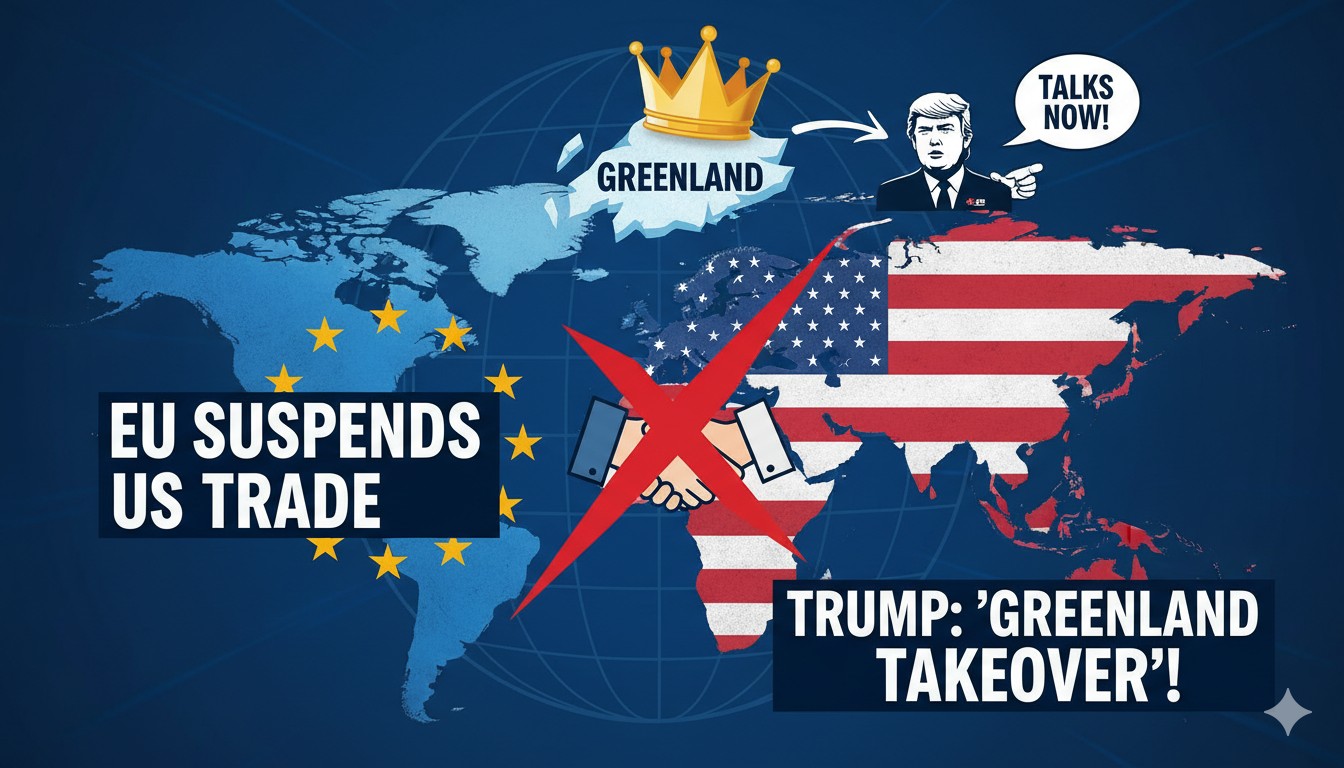
“The European Union has suspended implementation of a key trade agreement with the United States in response to President Donald Trump’s renewed calls for acquiring Greenland, coupled with threats of escalating tariffs on several European nations. This move heightens transatlantic tensions, risks igniting a broader trade war, and has triggered market volatility, with potential economic repercussions including higher import costs and disrupted supply chains for both economies.”
Escalating Transatlantic Rift Over Greenland
The European Parliament’s decision to freeze the trade deal, originally struck in July 2025 at Trump’s Turnberry golf resort in Scotland, marks a significant setback in US-EU relations. The agreement had aimed to avert a full-scale tariff war by capping duties on European goods at 15% while providing zero tariffs on strategic sectors like pharmaceuticals, semiconductors, and aircraft components. In exchange, the US committed to reducing barriers on certain EU exports, including lobster and industrial goods.
However, Trump’s weekend announcement of a 10% tariff on imports from eight European countries—set to take effect February 1 and rise to 25% by June 1 unless a deal on Greenland is reached—prompted swift backlash. The targeted nations include Denmark (as Greenland’s sovereign), France, Germany, the Netherlands, Norway, Sweden, Finland, and the United Kingdom. EU officials view this as coercive leverage, labeling it an assault on territorial integrity and alliance principles.
In a statement from Brussels, the Parliament’s International Trade Committee chair emphasized that continued threats left no choice but to halt legislative work on the deal’s implementation. This suspension indefinitely postpones the removal of EU import duties on various US products, potentially unraveling months of negotiations and exposing both sides to renewed economic pressures.
Trump’s Davos Remarks and Negotiation Push
Speaking at the World Economic Forum in Davos, Switzerland, President Trump reiterated his interest in Greenland, describing it as vital for US national security due to its strategic Arctic position, rare earth mineral reserves, and potential military basing opportunities. He explicitly ruled out using force to acquire the territory but urged “immediate negotiations” with Denmark and its European allies to discuss a “complete and total purchase,” drawing parallels to historical US territorial acquisitions like Alaska and the Louisiana Purchase.
Trump argued that US protection of Europe through NATO justifies concessions, warning that failure to engage could lead to reevaluations of American commitments. This stance has unified European leaders in opposition, with Danish officials rejecting any sale outright and EU Commission President Ursula von der Leyen calling the tariff threats a “mistake” that violates the spirit of their recent handshake deal.
The president’s comments followed a year of strained diplomacy, where Europe attempted to placate Trump through increased purchases of US liquefied natural gas, weapons systems, and agricultural products. Yet, the Greenland fixation—first floated during Trump’s initial term—has now escalated into a flashpoint, testing the resilience of transatlantic ties.
Market Volatility and Immediate Financial Reactions
Financial markets reacted sharply to the unfolding drama, reflecting investor concerns over a potential trade war reminiscent of the 2018-2019 US-China disputes. US indices rebounded modestly after Trump’s assurance against military action, with the Dow Jones Industrial Average climbing 400 points, or about 0.9%, in afternoon trading. The S&P 500 advanced 1.2%, buoyed by gains in defense and energy sectors, as investors bet on eventual de-escalation.
In contrast, European bourses faced downward pressure. Germany’s DAX index fell 0.8%, dragged by export-heavy automakers like Volkswagen and BMW, which could face higher costs on US-bound shipments. The FTSE 100 in London dipped 0.5%, with financials and miners underperforming amid fears of broader UK exposure. France’s CAC 40 declined 1.1%, highlighting vulnerabilities in luxury goods and aerospace.
Currency markets also shifted, with the euro weakening against the dollar to 1.078, down 0.4% for the day, as traders anticipated prolonged uncertainty. Bond yields rose slightly in the US, with the 10-year Treasury note at 4.15%, signaling expectations of resilient American growth despite the spat.
Potential Economic Ramifications
| Index | Today’s Change (%) | Key Drivers |
|---|---|---|
| S&P 500 | +1.2 | Relief over no-force pledge; tech and defense gains |
| Dow Jones | +0.9 | Industrial rebound; tariff threats seen as negotiable |
| DAX | -0.8 | Export fears; auto sector hit |
| FTSE 100 | -0.5 | UK tariff exposure; mining slowdown |
| CAC 40 | -1.1 | Luxury and aerospace vulnerabilities |
If unresolved, the standoff could inflict substantial costs. Analysts estimate that the proposed 10-25% tariffs would affect over $200 billion in annual trade flows from the targeted countries, raising prices for US consumers on everything from Danish pharmaceuticals and German machinery to French wines and Norwegian seafood. In retaliation, the EU has signaled readiness to reactivate paused tariffs on up to $108 billion of US exports, including bourbon, motorcycles, and agricultural staples like soybeans and peanuts.
This tit-for-tat could shave 0.2-0.5% off EU GDP growth in 2026, according to preliminary models from the European Central Bank, exacerbating existing challenges like high energy costs and sluggish manufacturing. For the US, the impact might be milder at 0.1-0.3% GDP drag, but sectors like aviation and tech—already sensitive to global supply chains—face disruptions.
Key affected industries include:
Aerospace : Boeing could benefit from reduced competition if EU tariffs bite Airbus, but reciprocal measures might hike costs for US-assembled planes using European parts. Boeing shares rose 1.5% today, while Airbus dipped 2.3%.
Automotive : German carmakers export $50 billion annually to the US; added tariffs could force price hikes or production shifts, impacting jobs in both regions.
Energy and Resources : Greenland’s untapped minerals, including rare earths essential for electric vehicles and renewables, underpin Trump’s strategic rationale. A US takeover might secure supply for American firms, but the dispute delays joint Arctic development projects.
Agriculture : US farmers, still recovering from prior trade wars, risk losing EU market share if retaliatory duties resume.
Broader implications extend to NATO cohesion, with Trump hinting at skepticism over alliance obligations if Europe stonewalls. European diplomats are convening an emergency summit to coordinate responses, potentially activating the bloc’s “anti-coercion instrument”—a tool allowing export controls or market access restrictions as a “trade bazooka” against perceived blackmail.
Sector-Specific Vulnerabilities
Drilling deeper, the pharmaceutical sector stands out as particularly exposed. The 2025 deal had shielded EU drug exports from higher duties, but suspension could revert rates to 20-30%, inflating costs for US hospitals and patients reliant on generics from Denmark and Germany.
In technology, semiconductor trade—valued at $100 billion bilaterally—benefits from zero tariffs under the pact. Freezing it risks supply bottlenecks for US chipmakers like Intel and Nvidia, who source equipment from ASML in the Netherlands.
Defense ties add complexity: Europe’s increased purchases of US arms, including F-35 jets and Patriot missiles, were part of appeasement efforts. Tariff escalations might prompt reevaluations, straining military interoperability.
Path Forward Amid Uncertainty
| Sector | US Exports at Risk ($B) | EU Exports at Risk ($B) | Potential Impact |
|---|---|---|---|
| Aerospace | 40 | 35 | Supply chain disruptions; higher assembly costs |
| Automotive | 20 | 50 | Job losses in manufacturing hubs; price inflation |
| Pharmaceuticals | 30 | 60 | Increased drug prices; generic shortages |
| Technology | 50 | 50 | Chip shortages; delayed innovation |
| Agriculture | 25 | 15 | Market share erosion; farmer subsidies needed |
As negotiations loom, both sides face incentives to compromise. Trump seeks a legacy win on national security, while Europe prioritizes unity and sovereignty. Informal talks at Davos suggest room for dialogue, but entrenched positions—Denmark’s firm “no” to selling Greenland and Trump’s linkage to tariffs—complicate resolution.
Investors are monitoring upcoming milestones: the February 1 tariff deadline, an EU leaders’ summit, and potential US executive orders formalizing threats. Until clarity emerges, volatility is expected to persist, with safe-haven assets like gold up 0.7% today at $2,650 per ounce.
Disclaimer: This article is for informational purposes only and does not constitute financial advice, investment recommendations, or endorsements. All information is based on publicly available data and should not be relied upon for making decisions. Readers are encouraged to consult qualified professionals for personalized guidance.




Leave a Reply