
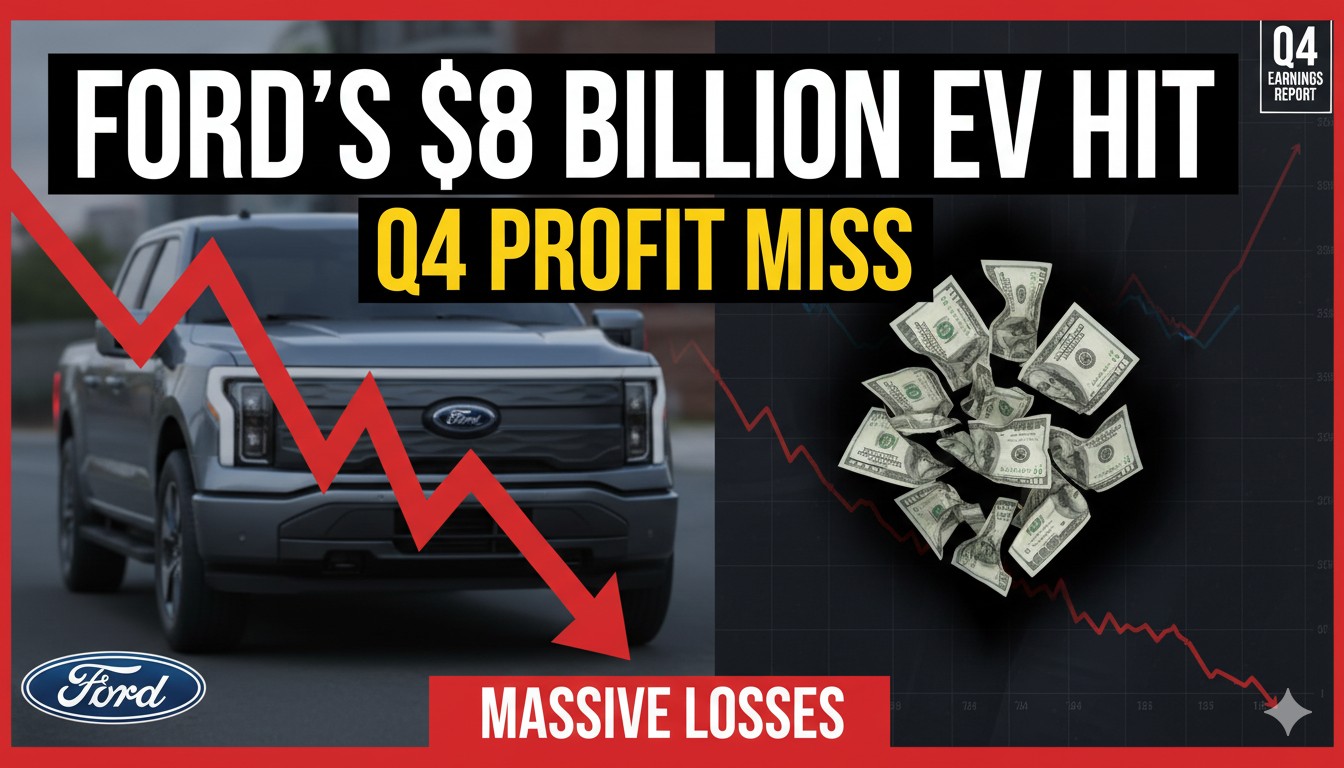
Ford Motor Company reported a significant fourth-quarter adjusted earnings miss and a full-year net loss of $8.2 billion, driven primarily by substantial charges and ongoing losses in its electric vehicle division, Model e. Despite record annual revenue of $187.3 billion and strength in its Ford Pro commercial and Ford Blue internal-combustion segments, special items including EV program impairments led to a $11.1 billion quarterly net loss. Adjusted EBIT for the year stood at $6.8 billion, below expectations, while the company guided for a stronger 2026 with $8-10 billion in adjusted EBIT.
Ford’s Challenging 2025 Financial Performance Amid EV Transition Pressures
Ford Motor Company delivered its latest quarterly results, revealing a mixed picture where top-line revenue showed resilience but profitability suffered heavily from strategic shifts in its electric vehicle ambitions. The Detroit-based automaker posted fourth-quarter revenue of $45.9 billion, a figure that exceeded some analyst projections despite a 5% year-over-year decline. This performance was supported by steady demand in key segments, though automotive revenue specifically came in at $42.4 billion.
Adjusted earnings per share for the quarter landed at $0.13, falling short of Wall Street estimates around $0.19. Adjusted EBIT reached $1 billion for the period, reflecting a notable drop from prior-year levels. The headline numbers were dominated by a massive net loss of $11.1 billion in the quarter, marking one of the company’s worst quarterly performances in recent history, comparable to challenges seen during the Great Recession era.
For the full year 2025, Ford achieved record revenue of $187.3 billion, up modestly by 1% from the previous year. However, the bottom line told a starkly different story: a net loss of $8.2 billion, a sharp reversal from profitability in 2024. This outcome stemmed largely from special items totaling billions, including major impairments and cancellations tied to the EV strategy overhaul announced late in the prior year. A $19.5 billion charge related to pivoting away from certain EV programs was a key factor, with the bulk—around $12.5 billion—recognized in the fourth quarter, contributing to the outsized GAAP loss.
The company’s adjusted EBIT for the full year was $6.8 billion, aligning closely with its own guidance of around $7 billion but missing higher analyst consensus figures near $8.86 billion. Adjusted free cash flow came in at $3.5 billion, sitting at the midpoint of expectations and providing some liquidity buffer despite the pressures.
Segment Breakdown Highlights Divergent Performances
Ford’s business units showed clear contrasts in 2025:
Ford Pro (commercial vehicles and services): This segment remained a powerhouse, generating over $66 billion in revenue and $6.8 billion in EBIT, achieving double-digit margins around 10.3%. It continued to benefit from strong demand for trucks and fleet solutions.
Ford Blue (internal-combustion and hybrid vehicles): Delivered $3.0 billion in EBIT on roughly $101 billion in revenue, with margins at 3.0%. While solid, this marked a decline from prior-year contributions due to various headwinds.
Ford Model e (electric vehicles and software): Posted an EBIT loss of $4.8 billion for the year, an improvement of about $300 million from 2024’s $5.1 billion loss. Quarterly Model e losses reached $1.2 billion, with negative margins exceeding 90%. EV revenue grew to $6.7 billion annually from $3.9 billion, but challenges persisted from pricing pressure, production halts (including for the F-150 Lightning), and the expiration of certain federal incentives.
Ford Credit : Contributed positively with $2.6 billion in earnings before taxes, up significantly year-over-year.
Additional drags on results included roughly $2 billion in tariff-related costs—double initial projections due to policy adjustments—and supply chain disruptions, such as a fire at a key aluminum supplier that hampered production.
Outlook and Strategic Shifts Point to Recovery Path
Looking ahead, Ford provided optimistic guidance for 2026, targeting adjusted EBIT of $8 billion to $10 billion and adjusted free cash flow of $5 billion to $6 billion. Capital expenditures are expected to range from $9.5 billion to $10.5 billion, including investments in energy-related initiatives. Segment expectations include continued strength in Ford Pro ($6.5-7.5 billion EBIT) and Ford Blue ($4-4.5 billion), with Model e anticipated to post losses of $4-4.5 billion.
Management emphasized a pivot toward more affordable, high-volume EVs built on a new universal platform, alongside partnerships (such as with Renault for European models). Profitability for the EV unit is now targeted around 2029, reflecting a more measured approach after earlier aggressive scaling. Cost reductions, structural efficiencies, and a focus on hybrid offerings are central to bridging the gap.
The results underscore the broader industry’s turbulence in transitioning to electrification amid evolving demand, competition from global players, and macroeconomic factors. Ford’s legacy strengths in trucks and commercial vehicles provided a counterbalance, but the EV investments continue to weigh heavily on near-term financials.
Disclaimer: This article is for informational purposes only and does not constitute investment advice, financial recommendations, or endorsements of any kind. Market conditions can change rapidly, and past performance is not indicative of future results.










Leave a Reply