
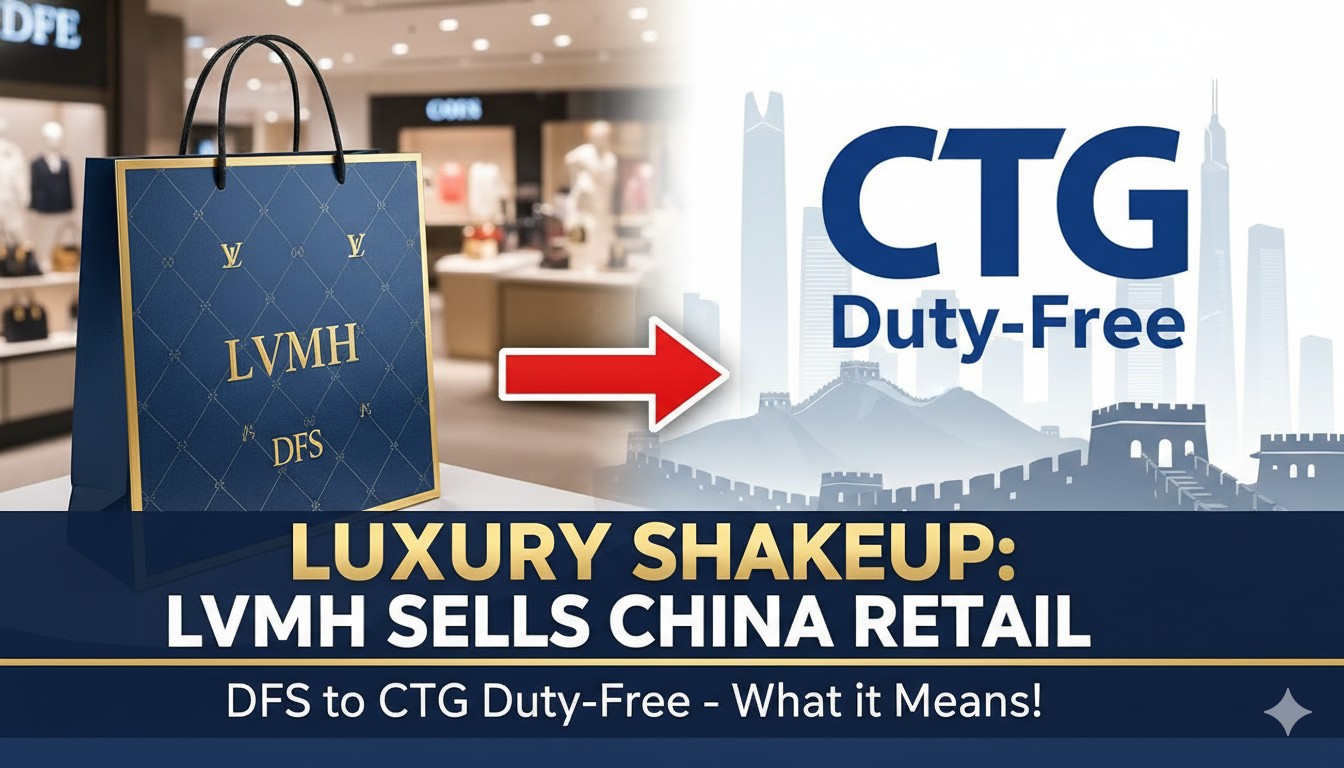
“LVMH-owned DFS has divested its travel retail operations in Greater China to China Tourism Group Duty-Free for approximately $395 million, including stores in Hong Kong and Macau plus intangible assets like brands and intellectual property; the transaction also involves LVMH and the Miller family subscribing to CTG’s H-shares, a strategic cooperation memorandum, and DFS scrapping its planned Hainan project amid broader exits from underperforming markets.”
Deal Overview The transaction centers on the sale of DFS Group’s retail footprint in Greater China to China Tourism Group Duty-Free, a state-controlled entity dominating the Chinese duty-free landscape. This includes physical stores located in key hubs such as Hong Kong and Macau, where DFS operates multiple outlets catering to high-end travelers seeking luxury goods from fashion to fragrances. Specifically, the deal encompasses two stores in Hong Kong and seven in Macau, excluding the City of Dreams location in Macau, which remains outside the scope. Beyond brick-and-mortar assets, CTG Duty-Free gains exclusive rights to a portfolio of DFS brands and intellectual properties tailored for use within Greater China, encompassing mainland China, Hong Kong, Macau, and Taiwan. The acquisition is executed through CTG’s wholly owned subsidiary, China Duty Free International Limited, with all proceeds delivered in cash.
This move signals a pivotal shift for DFS, which has historically pioneered luxury travel retail since its founding in 1960. As a majority LVMH-owned entity with co-founder Robert Miller as a key shareholder, DFS is streamlining its global operations by offloading regions where post-pandemic recovery has lagged, particularly due to subdued spending from Chinese tourists—a core demographic for the sector. The agreement underscores CTG Duty-Free’s ambition to solidify its position as a global player, leveraging its 79% market share in China’s duty-free segment to integrate DFS’s established infrastructure and enhance offerings in the Greater Bay Area.
Financial Details The deal carries a valuation of around $395 million, positioning it as a modest yet strategic divestiture for LVMH amid its vast portfolio exceeding hundreds of billions in market capitalization. Payment terms are straightforward, with cash settlement upon closing, expected within two months subject to regulatory approvals and standard conditions. In a complementary financial arrangement, LVMH and the Miller family are committing a portion of their proceeds—totaling approximately $118.5 million—to subscribe to nearly 12 million newly issued H-shares in CTG Duty-Free’s Hong Kong listing. This subscription is priced at HK$77.21 per share, reflecting an 11.7% discount to recent trading levels, and ties into a broader capital increase for CTG.
To illustrate the scale and context of involved entities, consider the following comparative financial snapshot based on recent performance metrics:
| Company | Market Capitalization (Approx.) | Annual Revenue (Recent Fiscal Year) | Key Segment Focus |
|---|---|---|---|
| LVMH Moët Hennessy Louis Vuitton | $350 billion | $95 billion | Luxury goods, including fashion, wines, spirits, and retail |
| DFS Group (Subsidiary of LVMH) | N/A (Integrated) | $4-5 billion (Estimated travel retail) | Duty-free and travel retail globally |
| China Tourism Group Duty-Free | $200 billion | $10 billion | Duty-free retail, primarily in China with international expansion |
These figures highlight LVMH’s dominance in the luxury ecosystem while underscoring CTG’s rapid ascent in travel retail, fueled by domestic tourism policies and economic incentives in regions like Hainan.
Strategic Implications For DFS, this divestiture aligns with a pattern of retrenchment from loss-making or low-growth areas. The company has been methodically exiting markets such as Guam after 50 years of operation, Hawaii following 63 years with closures across Waikiki, Honolulu Airport, and Kahului Airport, as well as withdrawals from New Zealand, Australia, and Saipan. Additionally, DFS is relinquishing control over European assets like Fondaco dei Tedeschi in Venice and La Samaritaine in Paris, now under new LVMH governance structures. The decision to abandon an ambitious shopping and entertainment project in Yalong Bay, Hainan—a duty-free haven—further emphasizes this strategy. Partnering with local developer Shenya Group, the Hainan initiative was poised to capitalize on China’s booming offshore duty-free shopping, but subdued travel volumes post-Covid and shifting consumer behaviors have rendered it unviable. By handing over Greater China operations, DFS can redirect resources to strongerholds in Japan, the United States, and the United Arab Emirates, where luxury travel retail shows more resilient demand.
On the buyer’s side, CTG Duty-Free stands to gain significantly by expanding its network in high-visibility locations like Hong Kong and Macau airports, which serve as gateways for international tourists. This acquisition not only bolsters CTG’s platform for promoting “China-chic” brands globally but also establishes an international business midpoint, accelerating its overseas layout. As a central state-owned enterprise, CTG aims to elevate retail experiences for both domestic and inbound travelers, potentially driving synergies in supply chain, inventory management, and customer loyalty programs. The memorandum of understanding (MOU) between CTG and LVMH paves the way for deeper collaborations, particularly in retail sectors where alignments exist with LVMH’s maisons—encompassing fashion labels like Christian Dior and Loewe, spirits such as Hennessy and Glenmorangie, hard luxury from Bulgari and TAG Heuer, and beauty via Tiffany. Potential joint ventures could span product sales, boutique establishments, brand promotions, cultural exchanges, travel services, and enhanced customer experiences, leveraging each party’s strengths to tap into Greater China’s affluent consumer base.
Market Impact and Broader Context The luxury travel retail sector has faced headwinds since the pandemic, with Chinese shoppers—historically accounting for a third of global luxury spending—curtailing international trips due to economic slowdowns, geopolitical tensions, and domestic policy shifts favoring onshore consumption. Hainan’s duty-free sales, for instance, have surged as an alternative, drawing billions in revenue that might otherwise flow to offshore hubs like Hong Kong. This deal reflects broader industry consolidation, where local giants like CTG absorb foreign assets to dominate regional markets, while multinationals like LVMH refocus on core competencies.
Stock market responses have been telling: CTG Duty-Free’s H-shares in Hong Kong climbed as much as 12% intraday before settling with a 3.7% gain at HK$90.65, signaling investor optimism about the acquisition’s growth potential. Similarly, its Shanghai-listed shares rose up to 7%, closing 2.9% higher at 96.09 yuan. In contrast, LVMH shares experienced volatility, dipping around 1.1% to open at 576.20 euros, though broader declines of up to 4.8% were largely linked to external factors such as potential U.S. tariffs on European goods amid ongoing trade disputes. Analysts view the transaction as neutral to positive for LVMH, shedding a non-core, underperforming unit while retaining influence through the share subscription and MOU.
Looking ahead, this partnership could reshape luxury retail dynamics in Asia, with CTG potentially emerging as a formidable counterweight to global operators. For U.S. investors eyeing luxury and retail sectors, the deal highlights opportunities in emerging market expansions but also risks tied to geopolitical sensitivities and fluctuating tourism flows. Key watchpoints include regulatory clearances, integration execution, and how collaborative initiatives translate into revenue uplift for both entities.
Disclaimer: This article is for informational purposes only and does not constitute financial advice, investment recommendations, or endorsements of any products or services. All information is based on publicly available sources.




Leave a Reply