
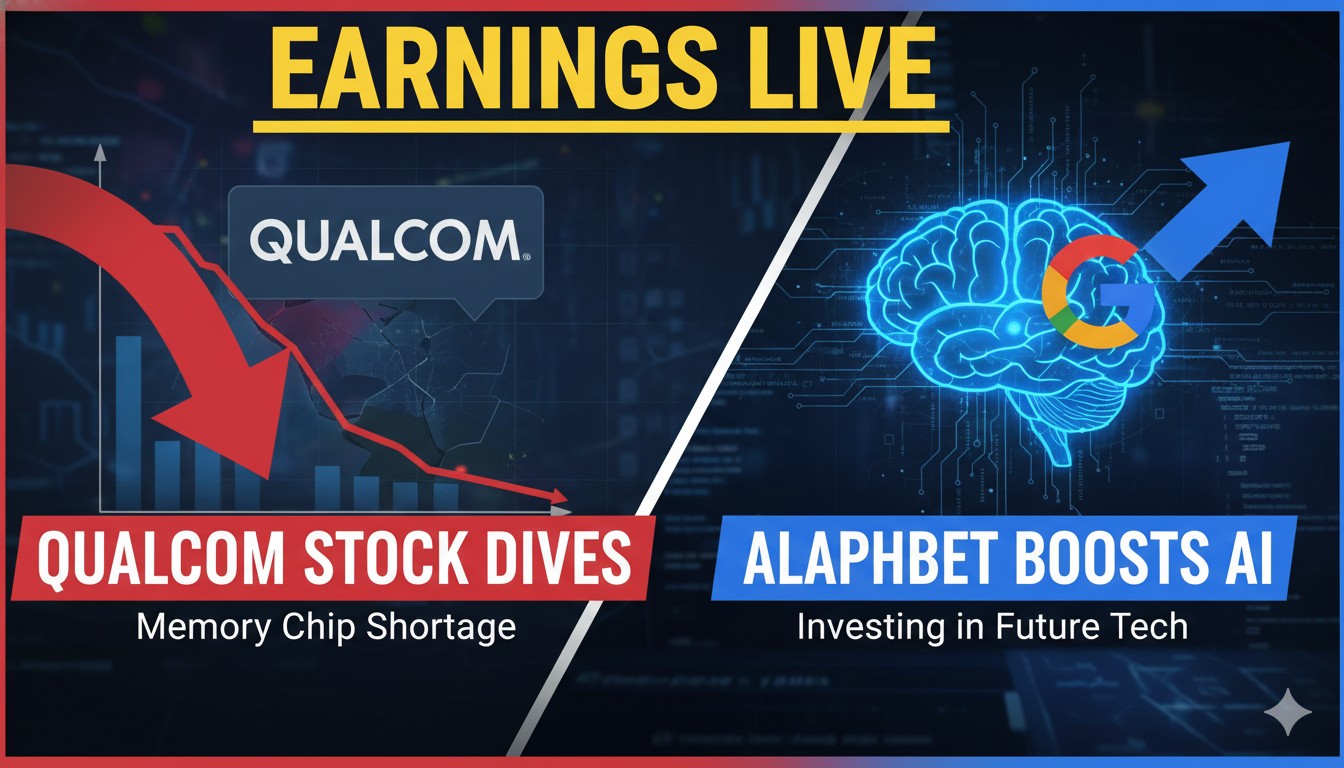
“Qualcomm’s Q1 fiscal 2026 earnings surpassed expectations with adjusted EPS of $3.50 and revenue of $12.25 billion, but shares dropped over 10% after a weaker-than-expected Q2 outlook tied to a global memory chip shortage impacting smartphone demand. Meanwhile, Alphabet reported strong Q4 2025 results with EPS of $2.82 and revenue of $113.83 billion, announcing plans to nearly double capital expenditures to $175-185 billion in 2026 for AI infrastructure, highlighting the diverging paths in the tech sector amid supply constraints and innovation drives.”
Qualcomm’s Earnings Beat Overshadowed by Supply Chain Woes
Qualcomm delivered a solid performance in its fiscal first quarter of 2026, posting adjusted earnings per share of $3.50, which beat analyst estimates of $3.41. Revenue came in at $12.25 billion, slightly above the anticipated $12.21 billion, marking a 5% increase from the same period a year earlier. The growth was primarily fueled by robust demand in premium smartphones and expansion in automotive and Internet of Things segments. Handset revenues, a core part of the business, rose modestly, supported by flagship launches and partnerships with major manufacturers.
However, the positive results were quickly eclipsed by a cautious outlook for the second quarter. The company guided for adjusted EPS between $2.45 and $2.65, falling short of the consensus around $2.66. Revenue projections were set at $10.2 billion to $11.0 billion, below the expected $11.1 billion. Executives attributed the shortfall entirely to an escalating memory chip shortage, particularly in dynamic random-access memory (DRAM), which is critical for pairing with Qualcomm’s processors and modems in smartphones.
The shortage stems from a broader industry shift where memory manufacturers are redirecting production capacity toward high-bandwidth memory (HBM) to meet surging demand from artificial intelligence data centers. This reallocation has created a supply crunch in standard memory components, driving up prices and forcing smartphone original equipment manufacturers (OEMs) to adopt conservative inventory strategies. Chinese handset makers, a significant market for Qualcomm, have been particularly affected, reducing chipset orders as they grapple with higher costs and uncertain availability.
Analysts project that global smartphone shipments could decline by as much as 7% in 2026, exacerbated by these rising memory prices. The entire mobile ecosystem is feeling the pinch, with potential ripple effects on consumer pricing and market growth. Qualcomm’s leadership emphasized that while consumer demand for high-end devices remains strong, the availability of memory will ultimately dictate the scale of the handset market throughout the year. This dynamic is expected to persist, potentially defining performance across the fiscal period.
In extended trading, Qualcomm’s stock plunged as much as 11.7% from its closing price of $148.89, reflecting investor concerns over near-term headwinds. The shares have already declined over 11% year-to-date, underperforming amid broader worries about market share erosion and supply chain vulnerabilities. Despite the challenges, the company highlighted progress in diversification, including record automotive revenues and new design wins in industrial IoT and robotics.
Key Impacts of the Memory Shortage on Qualcomm’s Outlook
| Qualcomm Q1 FY2026 Financial Highlights | Actual | Expected | YoY Change |
|---|---|---|---|
| Adjusted EPS | $3.50 | $3.41 | +2.6% |
| Revenue (in billions) | $12.25 | $12.21 | +5% |
| Handset Revenue (in billions) | $7.8 | $7.6 | +3% |
| Automotive Revenue (in billions) | $0.65 | $0.62 | +15% |
| IoT Revenue (in billions) | $1.5 | $1.45 | +7% |
Inventory Caution Among OEMs: Smartphone makers are scaling back orders to avoid overstocking amid volatile memory prices, leading to reduced chipset demand in the short term.
Margin Pressure: Higher memory costs are squeezing gross margins, with Qualcomm anticipating a sequential slowdown in handset revenues.
Market Share Considerations: While Qualcomm maintains a strong position in premium tiers, competition from in-house chips by rivals could intensify if supply issues prolong.
Long-Term Resilience: The company remains optimistic about AI-enabled smartphones and expansion into data centers, but near-term constraints may cap growth.
Executives noted that the memory crunch is an industry-wide issue, not isolated to Qualcomm, and could influence the broader semiconductor landscape. Efforts to mitigate include strategic acquisitions targeting high-performance computing capabilities, aiming to bolster positions beyond traditional mobile markets.
Alphabet’s Robust Results Fuel AI Ambitions
Shifting focus to Alphabet, the Google parent company reported impressive fourth-quarter 2025 earnings, with adjusted EPS of $2.82 exceeding estimates of $2.63. Revenues soared to $113.83 billion, an 18% jump year-over-year, or 17% in constant currency, driven by momentum across search, cloud, and advertising. Google Search revenue climbed 17%, while Cloud revenues accelerated by 48%, underscoring the effectiveness of AI integrations in attracting enterprise clients.
The standout element was Alphabet’s aggressive investment strategy in artificial intelligence. Capital expenditures for 2025 totaled around $91.4 billion, nearly doubling from the prior year, and the company forecasts an even steeper ramp-up to between $175 billion and $185 billion in 2026. This massive outlay is earmarked for expanding data centers, developing advanced AI models like Gemini iterations, and enhancing infrastructure to support growing demand for cloud services and generative AI tools.
Leadership highlighted that these investments are already yielding returns, with Cloud backlog doubling to $240 billion and AI-driven features boosting user engagement on platforms like YouTube and Search. Subscriptions, including YouTube Premium and Google One, contributed significantly, reflecting a shift toward recurring revenue streams. Despite the heavy spending, operating margins held steady, supported by cost efficiencies and strong ad performance.
In premarket trading, Alphabet shares dipped about 4% amid broader market anxieties over escalating AI costs and potential supply constraints in chips and energy. However, the stock has been a top performer, surging over 65% in 2025 to push the market cap beyond $4 trillion, making it the world’s second-most valuable company. Innovations such as Waymo’s autonomous driving expansions and partnerships, including a deal with Apple for AI-powered Siri, further solidify its competitive edge.
Strategic Shifts and AI-Driven Growth at Alphabet
| Alphabet Q4 2025 Financial Highlights | Actual (in billions) | YoY Change |
|---|---|---|
| Total Revenue | $113.83 | +18% |
| Google Search Revenue | $68.5 | +17% |
| YouTube Ads Revenue | $12.2 | +15% |
| Google Cloud Revenue | $15.4 | +48% |
| Capital Expenditures (2025 Total) | $91.4 | +98% |
| Projected 2026 Capex | $175-185 | +92-102% |
Infrastructure Expansion: The bulk of the 2026 spending will fund data center builds and AI hardware, addressing bottlenecks in compute power and enabling faster model training.
Cloud Momentum: With a doubled backlog, Google Cloud is gaining traction against competitors, powered by custom TPUs and integrations with enterprise workflows.
Ad and Subscription Strength: AI enhancements are improving ad targeting and user retention, while subscriptions now represent a key growth pillar.
Risks in the AI Race: Escalating costs raise questions about profitability timelines, but executives assert that these investments are essential to capitalize on AI opportunities.
Broader Ecosystem Plays: Expansions in autonomous vehicles and health tech via Verily demonstrate diversification beyond core search.
The contrasting fortunes of Qualcomm and Alphabet illustrate the tech sector’s bifurcation: supply chain disruptions hampering hardware-dependent businesses, while software and cloud giants leverage AI to drive unprecedented scale. Investors are closely watching how these dynamics evolve, with potential implications for global tech valuations and innovation paces.
Disclaimer: This news report is for informational purposes only and does not constitute investment advice or tips. All information is derived from publicly available sources.








Leave a Reply