
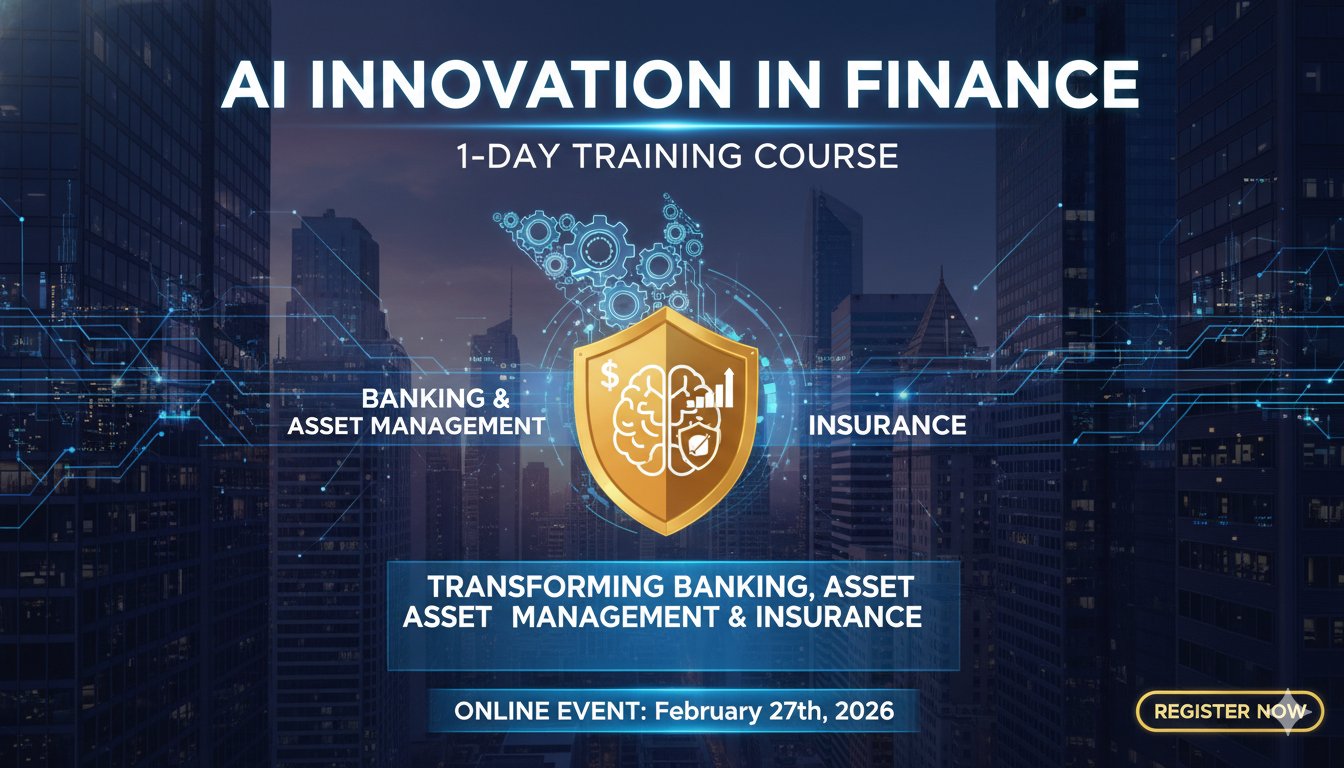
“As AI shifts from experimentation to enterprise-wide deployment in 2026, this one-day training arrives at a pivotal moment, enabling participants to grasp agentic AI’s role in automating workflows, enhancing fraud detection, personalizing services, and driving operational efficiencies in financial services—while addressing regulatory and ethical challenges head-on.”
AI Revolution Accelerating Across Financial Services
The financial sector stands on the cusp of profound transformation driven by artificial intelligence. In 2026, institutions are moving beyond pilot programs to full-scale implementation of AI technologies, particularly agentic AI—autonomous systems capable of handling complex tasks, making decisions, and orchestrating workflows with minimal human intervention. This shift promises exponential productivity gains, with projections indicating that generative AI alone could add hundreds of billions in annual value to global banking through enhanced efficiency and innovation.
In banking, AI is redefining customer engagement and back-office operations. Hyper-personalized experiences are becoming standard, powered by advanced analytics that tailor products, offers, and communications in real time. Agentic AI agents manage customer requests end-to-end, from origination to fulfillment, enabling a “10x bank” model where individual employees oversee AI teams for dramatically scaled impact. Fraud detection has advanced significantly, with AI models identifying anomalies and preventing threats at unprecedented speeds, countering surges in sophisticated attacks like deepfakes.
Asset management is witnessing AI’s migration from back-office support to front-office decision-making. Predictive modeling now identifies investment opportunities, conducts due diligence, and generates portfolio recommendations by processing vast datasets faster than human analysts. Robo-advisors have evolved into sophisticated platforms delivering bespoke advice, assessing client risk profiles, and optimizing strategies amid volatile markets. Firms are investing heavily in data infrastructure and governance to support these applications, ensuring models remain accurate and compliant.
Insurance is leveraging AI to streamline claims processing, risk assessment, and underwriting. Agentic systems automate repetitive tasks, provide real-time decision support, and reduce processing times substantially—some implementations have cut complex case assessments by weeks while improving accuracy and customer satisfaction. In property and casualty lines, AI enhances fraud identification and pricing models, while life and health segments benefit from personalized policy recommendations and predictive health analytics.
The training course structure emphasizes practicality. It begins with AI fundamentals, tracing its history from early machine learning to today’s generative and agentic models. Participants explore recent advancements, including large action models that enable AI to execute multi-step processes autonomously. Real-world case studies illustrate transformations: banks deploying AI for seamless embedded finance in non-financial platforms, asset managers using predictive analytics for trend spotting, and insurers applying AI to modernize operations amid rising claims complexity.
Key applications covered include:
Fraud and Risk Management : Advanced anomaly detection and predictive risk modeling that adapt to emerging threats.
Customer Experience Enhancement : Conversational AI interfaces and personalized financial guidance delivered via apps, wearables, and voice assistants.
Operational Automation : Agentic workflows that resolve issues, orchestrate compliance checks, and optimize liquidity without constant oversight.
Regulatory Compliance (RegTech) : AI-driven tools for monitoring, reporting, and ensuring adherence to evolving standards, turning compliance into a strategic advantage.
Investment and Portfolio Optimization : Machine learning for market forecasting, ESG integration, and dynamic asset allocation.
A dedicated segment addresses challenges and responsible deployment. Ethical considerations, bias mitigation, explainability, and data privacy remain critical as regulators scrutinize AI systems. Participants learn frameworks for governance, model validation, and traceability—essential for building trust in AI outputs. The course highlights the importance of synthetic data generation to augment training sets while protecting sensitive information, alongside strategies to counter AI-enabled fraud risks.
Comparative Impact of AI Across Sectors
| Sector | Key AI Applications in 2026 | Expected Benefits | Primary Challenges |
|---|---|---|---|
| Banking | Agentic customer service, fraud prevention, embedded payments | 27-35% front-office productivity boost, reduced fraud losses | Data privacy, integration with legacy systems |
| Asset Management | Predictive modeling, robo-advisory 2.0, portfolio optimization | Enhanced alpha generation, personalized strategies | Data quality, model explainability |
| Insurance | Claims automation, risk pricing, underwriting | 30%+ efficiency in claims, lower loss ratios | Regulatory scrutiny, ethical underwriting |
Professionals attending this February 27th online event will gain actionable knowledge to implement AI initiatives, evaluate vendor solutions, and navigate the transition to intelligent financial services. The workshop’s focus on practical insights from a seasoned expert ensures participants leave equipped to drive innovation in their organizations amid rapid industry evolution.
Disclaimer : This is a news report on industry developments and an upcoming training event. It is for informational purposes only and does not constitute financial, investment, or professional advice.









Leave a Reply