
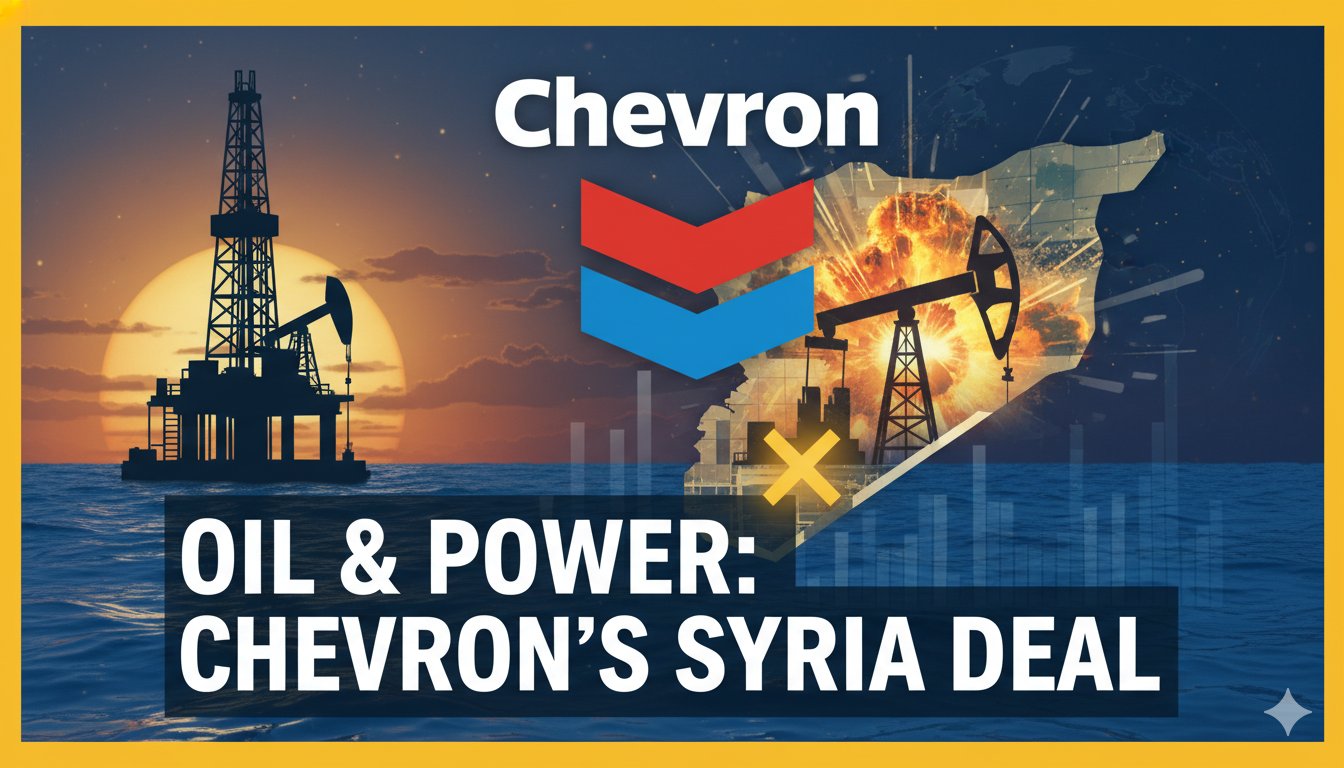
Chevron Corporation has entered into a memorandum of understanding with Syria’s state-owned Syrian Petroleum Company and Qatar-based UCC Holding to evaluate potential oil and gas exploration in Syria’s offshore territorial waters. This initial agreement represents Syria’s first structured step toward developing its untapped offshore hydrocarbon resources in the Levant Basin, a geologically promising region adjacent to major discoveries in Israel and Egypt. The deal, facilitated in Damascus with U.S. diplomatic presence, underscores emerging investment dynamics in Syria’s energy sector following recent territorial consolidations and signals possible new avenues for international energy partnerships.
Chevron Advances into Syrian Offshore Exploration
Chevron Corporation has formalized a preliminary memorandum of understanding (MOU) with the Syrian Petroleum Company (SPC) and Qatar’s UCC Holding to study and assess opportunities for oil and gas exploration offshore Syria. The agreement focuses on evaluating the potential within Syria’s Mediterranean territorial waters, positioning Chevron to conduct preliminary geological and technical assessments without immediate commitment to drilling or development.
This MOU arrives at a pivotal moment for Syria’s hydrocarbon sector. The country’s current production remains concentrated in onshore fields, primarily in the northeast, where fields like Al-Omar contribute the bulk of output. Proven onshore oil reserves stand at approximately 2.5 billion barrels, though years of conflict have significantly curtailed production capacity. Offshore areas, by contrast, remain virtually unexplored, despite their location in the Levant Basin—a geological formation known for substantial natural gas and potential oil accumulations.
The Levant Basin has already delivered world-class discoveries nearby. Israel’s Leviathan field holds an estimated 22 trillion cubic feet of natural gas, while Egypt’s Zohr field contains around 30 trillion cubic feet. These successes have transformed the eastern Mediterranean into a strategic energy corridor, attracting major international operators. Syria’s offshore blocks lie in close proximity to these prolific structures, raising expectations for analogous resource potential, though extensive seismic and exploratory work will be required to confirm prospects.
The agreement builds on prior, unsuccessful attempts at Syrian offshore exploration. In 2013, Russian firm Soyuzneftegaz secured a contract for Block 2 off the coast near Tartous and Banias, but escalating conflict led to the project’s abandonment within two years. The current MOU differs in its preliminary nature and its involvement of a U.S. supermajor alongside a Qatari partner, reflecting a broader push by Syria to attract foreign capital for energy rehabilitation.
Strategic Context and Regional Implications
For Chevron, the move expands its footprint in the eastern Mediterranean, where the company already holds interests in Israel’s Leviathan project. Participation in Syrian waters could offer long-term diversification, particularly as global energy demand evolves and operators seek new basins to offset maturing fields. The company’s expertise in deepwater and complex environments positions it well to lead technical evaluations, though any progression beyond assessment would depend on further agreements, regulatory approvals, and geopolitical stability.
Syria’s energy ambitions align with efforts to rebuild economic infrastructure following prolonged instability. Recent territorial changes have consolidated control over key onshore assets, potentially enabling greater focus on untapped offshore zones. The presence of U.S. special envoy Tom Barrack at the signing ceremony highlights diplomatic dimensions, suggesting coordination amid shifting regional alliances. Qatar’s involvement through UCC Holding adds a Gulf dimension, consistent with Doha’s growing role in Mediterranean energy projects.
Market and Investment Considerations
The announcement has drawn attention to Chevron’s broader portfolio strategy amid volatile commodity markets. Offshore exploration remains capital-intensive and high-risk, but successful discoveries in analogous basins have delivered substantial returns. Investors will monitor whether this MOU evolves into more concrete commitments, potentially influencing Chevron’s upstream spending allocations.
In the immediate term, the deal contributes to narratives around energy supply diversification away from traditional producers. While Syria’s offshore potential remains speculative, any material finds could eventually impact regional gas flows, particularly to Europe and the Middle East. For now, the agreement remains exploratory, with no production timelines or reserve estimates available.
Key Deal and Sector Highlights
Parties Involved : Chevron Corporation, Syrian Petroleum Company (SPC), UCC Holding (Qatar).
Scope : Evaluation of offshore oil and gas exploration opportunities in Syrian Mediterranean waters.
Status : Preliminary MOU; no binding exploration or production commitments.
Geological Setting : Levant Basin, adjacent to Leviathan (Israel) and Zohr (Egypt) fields.
Syria’s Current Production : Primarily onshore, centered in northeast fields; offshore undeveloped.
Historical Precedent : 2013 Russian-led project abandoned due to conflict.
Risk Factors and Outlook
Political and security considerations represent primary hurdles. Syria’s environment demands careful navigation of sanctions frameworks, regulatory changes, and local stability. Previous offshore initiatives faltered amid conflict, and any advancement will require sustained calm and international support.
Chevron’s involvement may also face scrutiny from stakeholders concerned with geopolitical complexities. Yet the company’s track record in politically sensitive regions demonstrates capability to manage such challenges through phased approaches and robust risk assessment.
The MOU signals early momentum toward unlocking Syria’s offshore potential, offering Chevron a strategic entry point into an underexplored basin. Future developments will hinge on initial study outcomes, additional partnerships, and broader regional stabilization.
Disclaimer : This is a news report for informational purposes only. It does not constitute financial advice, investment recommendation, or solicitation to buy or sell securities. Market conditions change rapidly, and readers should conduct their own due diligence.









Leave a Reply