
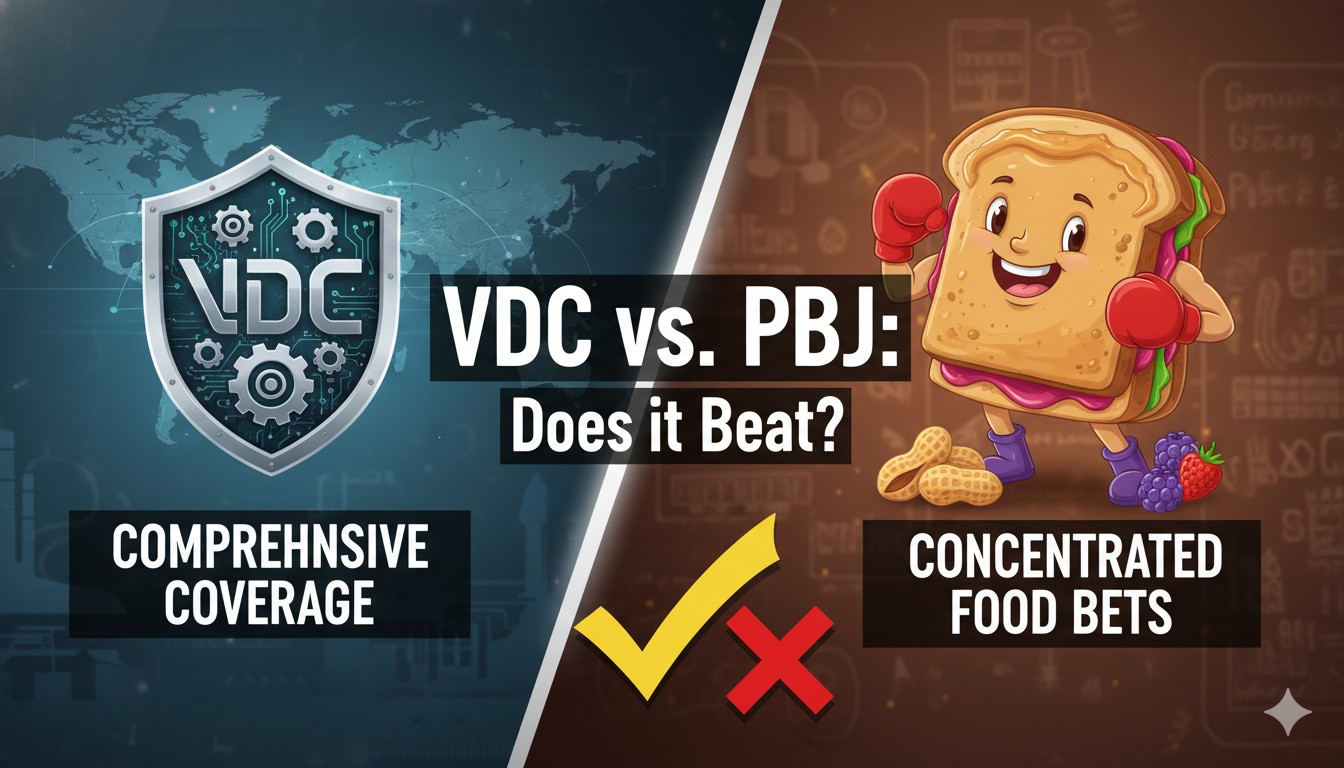
“The Vanguard Consumer Staples ETF (VDC) provides broad exposure to the consumer staples sector with lower costs and stronger long-term returns, while the Invesco Food & Beverage ETF (PBJ) focuses on a narrower food and beverage niche, offering potential for targeted growth but at higher expenses and increased volatility. Performance data shows VDC outperforming PBJ across multiple time frames, with VDC’s diversified approach yielding higher annualized returns over the past decade, though both funds serve defensive roles in portfolios amid economic uncertainty.”
ETF Overviews
The Vanguard Consumer Staples ETF (VDC) tracks a broad index encompassing companies involved in manufacturing and distributing essential consumer goods, including food, beverages, household products, and tobacco. This fund aims to mirror the performance of large, mid, and small-cap stocks in the sector, emphasizing stability and resilience during market downturns. With assets under management exceeding $9 billion, VDC appeals to investors seeking comprehensive coverage in non-cyclical industries.
In contrast, the Invesco Food & Beverage ETF (PBJ) employs a dynamic strategy focused exclusively on food and beverage companies, selecting around 30 stocks based on factors like growth potential, momentum, and valuation. This concentrated approach targets specific subsectors such as packaged foods, soft drinks, and agricultural products, potentially capturing upside from trends like health-focused innovations or supply chain shifts. PBJ manages about $100 million in assets, catering to those willing to bet on a narrower slice of the market.
Performance Comparison
Historical and recent performance metrics highlight key differences between the two funds. VDC has demonstrated consistent outperformance in longer-term horizons, benefiting from its diversified holdings that buffer against sector-specific risks. PBJ, while showing agility in short-term rallies driven by food industry trends, often lags due to its higher concentration and fees.
| Metric | VDC | PBJ |
|---|---|---|
| Current Price | $239.32 | $50.20 |
| Year-to-Date Return | 13.29% | 12.04% |
| 1-Year Return | 12.06% | 8.10% |
| 3-Year Annualized Return | 10.50% | 4.50% |
| 5-Year Annualized Return | 9.95% | 7.17% |
| 10-Year Annualized Return | 9.27% | 6.60% |
| Assets Under Management | $9.05 Billion | $99.12 Million |
| Expense Ratio | 0.09% | 0.61% |
| Dividend Yield | 2.10% | 1.72% |
These figures underscore VDC’s edge in cost efficiency and returns, particularly over extended periods where compounding effects amplify the impact of lower fees. For instance, a hypothetical $10,000 investment in VDC over the past decade would have grown more substantially than in PBJ, reflecting the benefits of broader exposure amid varying economic cycles.
Holdings and Sector Allocation
VDC’s portfolio includes over 100 holdings, spreading risk across a wide array of consumer staples companies. This diversification reduces dependency on any single subsector, providing stability even when food prices fluctuate or tobacco regulations tighten.
Top 10 Holdings for VDC:
Walmart Inc. (WMT): 15.07%
Costco Wholesale Corporation (COST): 11.65%
The Procter & Gamble Company (PG): 10.04%
The Coca-Cola Company (KO): 8.35%
Philip Morris International Inc. (PM): 4.67%
PepsiCo, Inc. (PEP): 4.50%
Altria Group, Inc. (MO): 3.41%
Mondelez International, Inc. (MDLZ): 2.48%
Colgate-Palmolive Company (CL): 2.19%
Monster Beverage Corporation (MNST): 2.05%
Sector breakdown for VDC leans heavily toward consumer defensive at 97.91%, with minor allocations to consumer cyclical (1.48%), industrials (0.33%), and basic materials (0.29%).
PBJ, with its concentrated strategy, holds approximately 30 stocks, allowing for deeper bets on food and beverage innovators but increasing vulnerability to industry-specific events like commodity price swings or consumer preference shifts.
Top 10 Holdings for PBJ:
Sysco Corporation (SYY): 5.20%
Corteva, Inc. (CTVA): 5.14%
Monster Beverage Corporation (MNST): 5.11%
PepsiCo, Inc. (PEP): 4.89%
The Hershey Company (HSY): 4.86%
The Coca-Cola Company (KO): 4.78%
The Kroger Co. (KR): 4.53%
The Kraft Heinz Company (KHC): 4.36%
Celsius Holdings, Inc. (CELH): 3.50%
The Andersons, Inc. (ANDE): 3.12%
PBJ’s sector allocation includes consumer defensive at 89.61%, basic materials at 5.15%, industrials at 2.91%, and consumer cyclical at 2.33%. Overlaps exist in holdings like KO, PEP, and MNST, but PBJ’s emphasis on food distribution and agriculture differentiates it from VDC’s inclusion of broader staples like household goods.
Risk and Volatility Metrics
Volatility remains a critical factor in assessing these ETFs, especially for risk-averse investors. VDC’s beta of 0.64 indicates lower sensitivity to market movements compared to PBJ’s beta of 0.72, making VDC a steadier choice during turbulent times. Sharpe ratios further favor VDC at 0.88 versus PBJ’s 0.56, suggesting better risk-adjusted returns for the broader fund.
PBJ’s concentrated nature exposes it to higher idiosyncratic risks, such as supply chain disruptions in agriculture or regulatory changes affecting beverage companies. For example, shifts in consumer demand toward healthier options could boost PBJ’s growth-oriented picks like CELH, but downturns in traditional food giants might drag performance. VDC mitigates this through its extensive diversification, offering a more predictable drawdown profile in recessions.
Liquidity and Trading Considerations
Liquidity metrics reveal VDC’s advantages in trading efficiency. With significantly higher average daily volume, VDC experiences tighter bid-ask spreads, reducing transaction costs for investors. PBJ, as a smaller fund, may face wider spreads during volatile periods, potentially impacting entry and exit points.
Both ETFs trade on major exchanges, but VDC’s larger AUM supports better institutional interest, which can stabilize price discovery. Investors using these in tax-advantaged accounts should note VDC’s lower turnover rate, minimizing capital gains distributions compared to PBJ’s dynamic rebalancing.
Strategic Portfolio Fit
For defensive positioning, VDC serves as a core holding in balanced portfolios, providing ballast against economic slowdowns while generating reliable dividends. Its low expense ratio enhances net returns, making it suitable for long-term buy-and-hold strategies.
PBJ, however, fits niche roles where investors anticipate outperformance in food and beverage subsectors, such as during commodity booms or innovation cycles in functional beverages. While its higher fees erode returns over time, the fund’s momentum-based selection could appeal to tactical allocators seeking alpha in concentrated bets.
Comparing the two, comprehensive coverage via VDC often outperforms concentrated strategies like PBJ in sustained bull markets for staples, but PBJ may shine in scenarios where food-specific trends dominate.
Key Investor Takeaways
Broader diversification in VDC reduces sector-specific risks, ideal for conservative portfolios.
PBJ’s focus allows for potential outperformance in targeted rallies but comes with elevated costs.
Long-term data favors VDC for compounded growth, while short-term opportunities might arise in PBJ during industry shifts.
Both funds emphasize defensive qualities, but VDC’s scale and efficiency provide a stronger foundation for most investors.
Disclaimer: This news report provides general information and tips based on publicly available sources. It is not intended as financial advice or a recommendation to buy or sell any securities.










Leave a Reply