
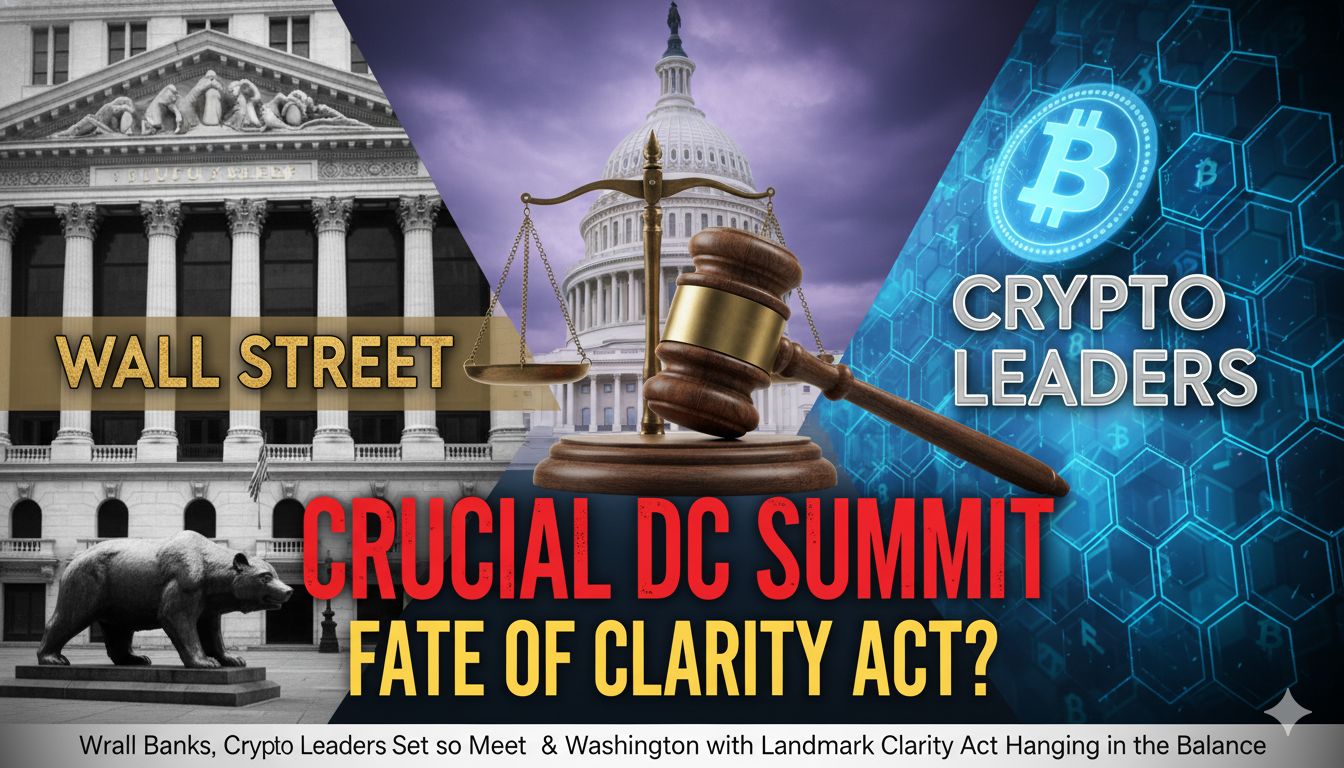
“Wall Street banks and cryptocurrency executives are gathering in Washington for high-stakes talks mediated by the White House, aiming to resolve a deadlock over the Clarity Act’s provisions on stablecoin yields. The legislation seeks to establish clear regulatory boundaries between the SEC and CFTC for digital assets, but disputes over interest payments on stablecoins have stalled progress in the Senate, pitting traditional finance against crypto innovators amid broader market volatility.”
The Clarity Act, formally known as the Digital Asset Market Clarity Act of 2025, represents a comprehensive framework designed to integrate digital assets into the U.S. financial system. It delineates jurisdiction between the Securities and Exchange Commission (SEC) and the Commodity Futures Trading Commission (CFTC), classifying certain digital assets as “digital commodities” under CFTC oversight while maintaining SEC authority over investment contracts. Digital commodities are defined as assets intrinsically linked to blockchain utility, excluding securities, derivatives, and stablecoins from this category. The bill requires maturity criteria for blockchains, such as decentralized control and limited ownership concentration, to qualify for lighter regulatory treatment.
Key provisions include the creation of new registered entities like digital commodity exchanges, brokers, and dealers, which must adhere to standards for custody, risk management, and anti-manipulation. Secondary transactions in digital commodities originally sold as investment contracts are exempted from certain SEC rules, provided disclosures are met. The act also addresses tokenized assets, ensuring parity in rules for blockchain-based stocks and bonds with traditional counterparts.
The Core Dispute: Stablecoin Yields and Competitive Threats
At the heart of the impasse is Section 404, which prohibits digital asset service providers and their affiliates from paying interest or yields solely tied to holding payment stablecoins. This extends bans from prior legislation, closing loopholes where exchanges could offer rewards funded indirectly by issuers. Banks argue this protects financial stability, preventing a flood of deposits shifting to higher-yielding crypto products that could undermine traditional banking models. Crypto firms view it as a protective measure for incumbents, stifling innovation and limiting consumer choice in a market where stablecoins already handle trillions in transactions.
The banking sector fears a potential exodus of deposits, estimated at up to $6 trillion if unrestricted stablecoin yields become widespread. Crypto advocates counter that yields reflect efficient treasury management, similar to money market funds, and banning them would drive activity offshore, eroding U.S. leadership in digital finance. This clash has led to withdrawn support from major players, delaying Senate Banking Committee markups and prompting White House intervention.
Stakeholders and Their Positions
Major Wall Street institutions, including JPMorgan Chase and Bank of America, are represented through trade groups pushing for stringent limits on stablecoin rewards to safeguard deposit bases. JPMorgan’s stock currently trades at approximately $306 per share, reflecting steady performance amid regulatory advocacy.
On the crypto side, Coinbase stands out as a vocal opponent of the yield ban, labeling it a “kill switch” for competitive products. Coinbase’s shares hover around $195, down amid broader market pressures. Other participants include advocacy groups like The Digital Chamber, emphasizing the need for a balanced framework that fosters growth without favoring legacy systems.
White House officials, including the special envoy for AI and cryptocurrency, are facilitating discussions to bridge gaps, underscoring the administration’s push for rules that promote innovation while addressing risks.
Market Implications and Volatility
The uncertainty surrounding the Clarity Act has contributed to heightened volatility in digital asset markets. Bitcoin, the bellwether cryptocurrency, is trading near $77,300, down over 5% in recent sessions, as traders weigh regulatory outcomes. Ethereum follows suit at around $2,310, experiencing sharper declines of nearly 9%, reflecting concerns over decentralized finance (DeFi) protocols that could face new oversight.
Stablecoins like USDT and USDC maintain pegs at $1, but their issuers monitor developments closely, as the act could reshape issuance and distribution. Tokenized real-world assets, a growing sector, stand to benefit from clearer rules but risk delays if compromises falter.
Potential Outcomes and Broader Impacts
| Asset | Current Price (USD) | 24-Hour Change (%) | Market Cap (USD) |
|---|---|---|---|
| Bitcoin (BTC) | 77,300 | -5.1 | 1.54 Trillion |
| Ethereum (ETH) | 2,310 | -8.9 | 278 Billion |
| Coinbase (COIN) | 195 | -2.2 | 52.5 Billion |
| JPMorgan (JPM) | 306 | -0.2 | 833 Billion |
If resolved favorably, the Clarity Act could unlock institutional capital by providing certainty for custody, trading, and tokenization. Compromises might involve tiered yields or exemptions for certain products, balancing competition with safeguards. Failure to advance could perpetuate “regulation by enforcement,” deterring investment and pushing talent abroad.
The talks highlight a shifting power dynamic, where crypto’s rapid growth challenges entrenched financial interests. As digital assets integrate with traditional systems, outcomes will influence everything from payment rails to tokenized securities, potentially reshaping everyday finance for American consumers.
Disclaimer: This news report is for informational purposes only and does not constitute financial advice, tips, or recommendations. Sources are not mentioned.











Leave a Reply